Fav Authors and Books

  • Elizabeth Gilbert
  • Chimamanda Ngozi Adichie
  • Katherine Boo
  • Vikram Seth

Monday, October 24, 2005

Keeping Gandhi's Spirit Alive


Manav Sadhna: Keeping Gandhi's Spirit Alive

(Published by Happy News, a newsmagazine dedicated to publishing positive news stories from around the world.)

An interested visitor to Ahmedabad, Gujarat in India might be dismayed at the few remaining traces of Gandhi's world-transforming spiritual and political philosophy. The city that once brought to mind the life and ideals of one of the greatest men the world has seen is, in recent times, being remembered for its communal violence and gigantic urban wealth divide.

One ominously recalls the words of renowned American political activist Martin Luther King Jr., who warned, "We may ignore Gandhi at our own risk." Though it may seem that India is treading the risky path of indifference, a trip to Manav Sadhna, which sits directly adjacent to the Gandhi Ashram in Ahmedabad, demonstrates that Gandhi's message is still resonating and continues to transform the lives of many.

A small, unassuming gateway near the end of the Ashram grounds leads one to a sign which reads in small letters, "Manav Sadhna: Service for All." The richly painted walls dance with the exuberant colors of traditional art forms; Gandhi's sayings are splayed across the walls. Children engaged in making Diwali cards of dazzling design sit in the verandah.

According to Manav Sadhna's Web site, the organization is a charitable institute, which works by the Gandhian principles of truth, non-violence, uplifting the poor and oppressed, promoting health and sanitation and educating the poor masses. It works in the area of education, nutrition, alternatives to child labor and medical aid to women and children living in the slums.

Through Manav Sadhna's Earn-and-Learn program, these children—who would ordinarily be earning money by scavenging, boot-polishing or ragpicking—are able to earn money, attend educational classes and leave with a nutritional meal in a positive environment.

When asked what he likes best about Manav Sadhna, a 12-year-old boy named Nagchi said he liked everything. "I like what I learn, I like how I am treated, and most of all, I feel happy being here."

Nagchi, who used to push a vegetable cart, heard about Manav Sadhna through a friend and decided to join. True to its Gandhian ethos, Manav Sadhna is cherished by many as a champion of the poor.

Established in 1992 by a group of three dedicated young individuals with the intention of eradicating child labor, Manav Sadhna has blossomed into a powerhouse of service activity with over 26 programs in domains as diverse as health care, nutrition, employment, vocational training and education.

Yet the emphasis in all programs, co-founder Jayesh Patel explained, is on serving with love. Love, he stresses, has the power to transform individuals to an extent that is unmatched by material giving. It also has the power to reach out to a vast number of people, both beneficiaries and donors.

From 70 beneficiaries at its inception, the organization now provides daily meals and support for over 600 children and 1,100 pregnant, lactating and widowed women. Empowerment of women is at the core of many of the organization's programs, Patel added, given the variety of injustices that are afflicted upon the health and dignity of women, especially in slums.

Many sit around Patel, waiting for a few minutes to speak with this man who exudes a spiritual goodness. He greets a woman named Anandiben and asks her how she is faring. Anandiben's husband threw acid upon her and her children five years ago; she was left blind and with only a thin layer of skin.

Through Manav Sadhna, she learned how to walk and slowly began to rebuild her life. Upon being addressed, a radiant smile lights up her face, and she replies that she has been doing well ever since she encountered Manav Sadhna.

Manish Barod, a 26-year-old who runs a number of programs including the street school, explained the positive sentiments experienced by many who associate with the organization.

"Here, one receives not only a future but a family, as well."

Barod was brought as a child by Patel, who found him, with burnt hands and a runny nose, selling acid near the Tekra slums. Health and hygiene have been cornerstones of the organization since its inception. Children's nails are routinely checked to make sure they are kept short. If the stray long nail is spotted on anyone he encounters, Patel will pull out his nail cutter and cut it himself.

"We may not have a pen," said a worker who develops innovative designs for the handicrafts made by the children, "but every Manav Sadhna worker always has a nail cutter in their pockets."

The importance of maintaining basic personal hygiene and good nutrition is woven into every program's daily curriculum and is regularly impressed upon the children. The results of this meticulousness have been far-reaching. Growth charts show that the children both acquire diseases at a slower rate than other slum inhabitants and also spread the hygiene lessons to other family members.

"It is not enough that our ears be feasted, that our eyes be feasted, but it is necessary that our hearts have got to be touched and that our hands and feet have got to be moved," Gandhi once said, articulating his support for the marriage of action and spirituality, a philosophy for which he has been forever immortalized.

Indeed, if he were to ever again walk down his hallowed grounds and catch a glimpse of the sublime radiance emanating through a tiny gate at the end of the ground, Gandhi would be pleased.

Sunday, August 28, 2005

Revolutionary Initiative


Revolutionary initiative (The Hindu, Aug 28th 2005)

SMITA JAIN

"THE solution for a major health hazard that afflicts our entire nation," says Anshu Gupta of Goonj, "is as simple as providing clean cloth." In his matter-of-fact manner, Anshu went on to explain the modus operandi behind Delhi-based Goonj's latest revolutionary cloth-recycling initiative: collecting donated cotton cloth to create sanitary napkins for millions of women across the country.

Unconventional

Goonj's history and programmes show that the organisationand its founder Anshu Gupta, are anything but ordinary. While many in the development sector tend to seek macro-solutions for social issues, Goonj was founded in 1999 with the simple goal of meeting the clothing needs of less-privileged people by utilising clothing donated by those more privileged. In this way, the organisation revolves around a widely known but seldom-implemented philosophy: one person's rags can indeed be someone else's riches, especially in context of India's gigantic urban-rural divide.

Cloth, Anshu stresses, is one of three basic necessities for humankind, yet few agencies give it much importance. "We document the number of people who die of floods and of earthquakes. Yet how often has the Government ever counted the numbers who die — mind you, preventable deaths — of the cold everyday during Delhi's winters?"

Goonj's School-to-School programme, which recently won the Changemaker's Innovation Award for its excellence, involves a partnership between a privileged urban school and a rural school, in which urban students from give their rural counterparts school paraphernalia that they would normally have discarded. Schools that wish to participate in the programme are given reading material — printed on one-side used paper — to distribute. Thus, children are sensitised on issues facing their less-privileged counterparts, and are encouraged to think about the value of their own education and the ways they can help children in less-fortunate circumstances.

Goonj's latest project to utilise donated cotton clothing for creating sanitary napkins is based on the knowledge that many women — and hence their families — suffer major health consequences on account of using unhygienic cloth during menstruating days. This can lead to infections, which can cause multi-organ failure, infertility, and in certain circumstances, even cervical cancer. The consequences can also be multi-fold, as an infection can have an effect not only on the woman, but on the lives of her children born and unborn. The situation in India is not one to be taken lightly; indeed, India has one of the highest infant and maternal mortality rates in the world.

Needless to say, few women and even fewer men would dare to address this issue, preferring instead to keep the "dirty laundry in the house". Therefore, it came as a surprise to hear this Ashoka Fellow nonchalantly discussing the motivations behind his latest endeavour. "I have travelled far and wide across India, and everywhere, the situation is the same. Since menstruation is considered to be `pollution', women use the dirtiest cloth in the house — cloth that has been used to clean the floors, the bathrooms. And because it is imperative that the cloth be hidden from the neighbours, it does not ever see the light of day.

First step

Furthermore, there are usually two or three women in a household all using the same cloth. "And in this context of shame, of extreme health-risks, we often overlook this reality and give them lectures on reproductive health and maternity care. We still have a long way to go, but providing some clean cloth is a good first step." In fact, the gravity of the situation struck Anshu most deeply when a village woman in Uttar Pradesh told him how her sister had died of tetanus acquired through a cloth she had used during her menstruating days. The cloth was from a sari blouse, on which the hooks had not been removed.

Goonj is seeking donations of clean cotton clothing and bed sheets, which can be donated at any of Goonj's collection centres. They are also looking for funds to purchase of a sterilising machine to clean the donated cloth. If you would like more information on Goonj's activities or would like to donate, contact Anshu at 98681-46978 or anshu_goonj1@yahoo.co.in, or access www.goonj.info

Read the article: http://www.hindu.com/mag/2005/08/28/stories/2005082800100400.htm


Sunday, August 07, 2005

An Indian in Shanghai

The Hindu, April 10th 2005

Hesistant metropolis or a strange land of bicycle avalanches? SMITA JAIN discovers a brand new China.

AP

For peace of mind -- legendary Chinese figures representing (from left) prosperity, happiness, and career achievement.

I NEVER expected to live in China, so when I found myself heading to Shanghai last summer to work at a procurement firm, I wasn't sure what to expect. I'd met few who'd been to the country, and from second and third-hand reports I'd heard, I imagined a strange land of bicycle-avalanches and where vegetarians ate grass. From what I'd read about China's tumultuous history, I expected Shanghai to be a hesitant metropolis inching its way toward capitalist glory, somewhere on the brink between the Past and Present, and encumbered by a rebellious populace.

My arrival at the gigantic, glass-panelled, world-class Pudong Airport and my subsequent ride to the city on the Maglev (the fastest train in the world), were enough to shatter many of my misperceptions. Gigantic billboards flashed latest London-Paris fashions, while others glorified the latest Chinese icons. As I soaked in the innumerable skyscrapers, malls and modern cityscape, I realised that this was in fact a Brand New China that was unapologetically racing forward on the global superhighway.

The confluence of concrete with the teeming populace and street-vendors gave Shanghai a decidedly NYC-meets-Mumbai feel, but with a major difference: the absence of English. I'd visited parts of the world where English is not the vernacular, but the psychological impact of walking through streets with signs, street names, and general conversation solely in Mandarin, was unparalleled.

Curiosity about India

At work, I received an excited welcome. Most of my colleagues had never met any Indians before, and they were curious to learn about Indian culture. Some had seen Bollywood films during their childhood, and were enamoured by the joyful songs and dances. During lunch break on my first day, they crowded around me as I opened up my spartan lunch, and the questions came pouring out: Why was I vegetarian? Would I be able to bear children? What are Indian languages like? Why doesn't India institute a one-child policy like China? Could India "catch up" with China?

As I waded through the questions, peering at the bright-eyed, curious faces around me, it struck me that for the first time, I was in a country nearly-untouched by Indian culture. While they were proud of China's achievements, they had positive impressions about India. India, they believed, was culturally and economically similar to China, and was thus a key partner for China in its bid to offset Western domination. They believed they had much to learn from India in terms of IT and English-skills, but when it came to food ... Indians sure were missing out on some tasty eel meat and chicken feet.

Eating out

AFP

Growing economic prosperity -- a bird's eye view of Shanghai.

The few vegetarian restaurants in the city were undoubtedly the saving grace for my vegetarian taste buds. (I soon found that to expect vegetarian food in a local eatery without a basic command of Chinese bordered on the preposterous.) Shared meals at typical family-style restaurants provided interesting cuisine etiquette lessons. Dishes are served on a revolving plate in the centre of the table, and food is deftly picked up with chopsticks as it comes by. Admittedly, chopstick-consternation led me to the ingenious idea of putting servings directly on my plate, and a gentle nudge from a colleague brought home the lesson that it is considered "barbarous" to actually place a helping on your plate. Fortunately, I didn't have to resort to a grass-diet; my Chinese friends made sure that lip-smacking tofu and vegetable dishes were aplenty.

Aware of the difficulties of getting settled in Shanghai without any knowledge of Mandarin, my colleagues often went out of their way to make sure I had no problems. This warmth and hospitality was echoed throughout my further travels in China, and was accentuated after I began speaking basic Mandarin. I remember getting into a cab one afternoon, only to find the driver turning to look at me curiously. He said excitedly in Mandarin, "Indian films! Song, dance, very good!" after which he burst into Amitabh-esque dance gyrations. On a train to Erlian in Northern China, fellow passengers crowded around me to stare and listen to my broken Mandarin. They immediately broke out into smiles, shook my hands and graciously complimented me on my command of the language! Local people whom I came in contact with were extremely pleased at even meagre attempts to speak Mandarin, and asked many questions about my heritage.

Though Shanghai provides an interesting window into modern China, my travels outside highlighted diverse facets of Chinese culture. In the beautiful water-towns of Tong-Li and Hangzhou, I gained an insight into slower, more traditional patterns of life. A climb up the jagged, perilously steep pilgrimage mountains of Huangshan and Taishan to see the awesome ancient Buddhist at their peaks, gave me a glimpse of China's deeply religious past.

With its abundant natural beauty, world-class cities and hospitable people, China undoubtedly fulfils most travellers' aspirations. Probe a little deeper, however, and you'll probably find more than you bargained for.

Monday, August 01, 2005

Vishalla: A Museum and Restaurant


(Housecalls Magazine, December 2005)

Imagine a place that combines relaxation with rural charm and home-cooked food, yet is located within the confines of a city. Sound impossible? Not so in Ahmedabad, where designer Surendra Patel has inspired a new generation of ‘feel good’ restaurants with his brainchild Vishalla Restaurant. The restaurant, located on the Ahmedabad-Baroda highway, has become a must-visit for visitors to Ahmedabad not only on account of its lip-smacking (and healthful!) rendition of traditional Gujarati food served in a village-like setting, but also for its unique Utensil Museum. The museum, which houses over 4000 pieces of traditional Indian houseware, is the only one of its kind in the world and is worth a visit. Providing something for all, Vishaala Restaurant offers an exciting experience and a sumptuous feast, not only for the stomach.

The idea for Vishalla restaurant, says Surendra, came from observing the ever-growing presence of stress and tension in urban dwellers’ lives. “Over the years, I observed that city folk always were always seeking places go to after work in the evenings – maybe to a garden, a restaurant, a temple, or a pub – anywhere, just to relax. Yet even many of these places afforded little mental peace. I thought to myself, why not create a restaurant with an ambience of relaxation and a natural setting, for a tension-free night out, away from the clamor and clang of the city?” Thus, in 1978, he began Vishalla Restaurant with the intention of creating a place of village-like serenity, openness and close connection to nature, as a kind of ‘retreat’ for urban folk. “The restaurant aims to connect urban dwellers to nature in a meaningful way,” says Surendra. “We utilize natural elements as far as possible, and minimize use of artificial material like plastic and steel. The restaurant is open air. We even use a natural air freshener,” he says with a grin, referring to the use of loban, a tree extract that is used in villages to ward off insects and purify the air.

Vishalla -- which means vast in Hindi – stands true to its name; there are no physical barriers in the form of doors or walls. This architectural peculiarity accentuates the feeling of vastness and openness, Surendra says, “and signifies the freedom of the mind”. The entire complex is situated out-of-doors, yet the artful use of bamboo, dirt lanes and the natural cover of dense foliage leaves one with the sense that is one is in a space in between the indoors and outdoors. A diya-lit entrance way beckons one to the interiors; traditionally-clad Gujarati men, replete with colorful dhotis and turbans, offer hearty greetings and provide a brief introduction on the gastronomic delights to come. The ambience created by the bamboo, low-lighting and greenery set an ambience that is at once peaceful and ethereal.

The Museum is housed in a partially-covered bamboo construction; its natural elements-inspired décor makes it seem as though it has just sprung up from the earth. A Shivaji temple surrounded by a pool of water sits majestically at its interior, heightening the aura of antiquity that envelops the place. The utensils, astonishing in their number and variety, line the four walls of the museum. The collection began as a hobby of Surendra’s; it was a striking incident that sparked off the idea for the creation of a museum. Soon after Vishalla was opened, Surendra went to a village in Rajasthan to collect a few ornamental vessels. There, he found the antique seller melting most of his collection for sale of the metal. Further travels showed the same thing happening in other parts of the country, and he was saddened that artifacts of such cultural and aesthetic value were being lost purely for monetary reasons. His designer-instincts overcame him, and he decided that he would begin a museum for traditional houseware from across the nation. In this way, he believed that he could not only showcase the fine craftsmanship of the utensils, but also lay the foundation for their preservation and appreciation for generations to come.

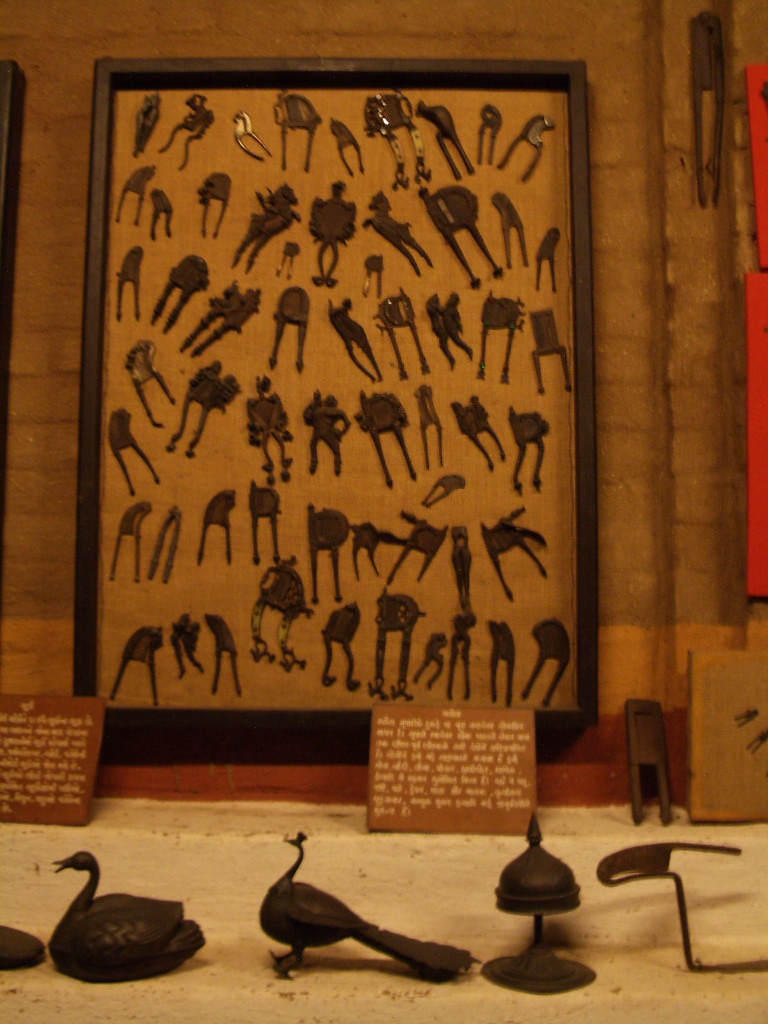
The collection - containing pieces as diverse as jewelry cases, dowry boxes, cauldrons, ancient idli makers, betel-nut crackers, treasures of maharajahs and camel saddles - is also diverse in terms of its geographical representation and antiquity. For one who might think that pieces from Gujarat might dominate the collection, it is not so; nearly 60% are from southern regions of India. The utensils range from 75 years to 1000 years in antiquity with the bulk being 150-200 years old. The oldest piece in the collection, a large copper pot, has been shown to be over 1000 years old. The well-informed guide, Mr. D. B. Patel, explains that Brahmi inscriptions – an Indian language that died not less than 1100 years ago – engraved in the interiors of the pot, are testament to its antiquity.

Not only are the pieces qualitatively diverse, Mr. Patel informs me, each is also exceptional in its own way. By way of explanation, he picks up what looks like an aging bell, and demonstrates that it is actually a ‘picnic-cup’ of yesteryears: a cup that contains 12 other cups of varying sizes, perfect for a family outing. Upon learning more about the pieces, one realizes that they are also unique repositories of information about lives of our ancestors. The guide points to a delicately carved brass opium-inhaler whose one end has the face of a snake, while the opposite end is engraved the head of a sheep. “The message is that the opium is equivalent to snake poison. Yet if one does not drink the opium,” he smiles, “one’s head becomes as hard as that of a sheep’s.”

After feasting on the cultural richness, it is time to experience some culinary delights. I am seated cross-legged in front of a low rising table, “which is the proper way according to Ayurveda, as this position keeps the stomach tension-free,” says Surendra. Accentuating the rustic feel, waiters in colorful garb spread leaf-plates and leaf-bowls on the table. I learn that even the food is designed to be calming for the body, being prepared with reduced ghee, oil, chili and salt. “We serve traditional Gujarati food, but as far as possible, we avoid deep-fried foods, preferring our items to be roasted or baked. We make sure to include lots of greens as well as sprouted salads. As far as possible, we also use organic ingredients,” Surendra informs me.

True to his words, a large assortment of vegetables, sprouts, condiments, achaar and chutney arrive as starters. The shaaks (vegetable dishes), made of vegetables often to be found in Gujarati homes – aaloo, channa, parval - arrive next, along with the Gujarati staple of kadhi. Those unfamiliar with Gujarati cooking might be surprised at the light sweetness of each dish; addition of gor (unrefined sugar) is typical of Gujarati cooking. Waiters quickly bring different kinds of roti - roasted thepla, rotlo and bhakra, and urge the abstemious to eat more. The snack dish of sandwich dhokro, a steamed bread-like item layered with chutney, arrives next. For the brave-hearted await the tasty Gujarati sweets of jalebi and dudhi halwa (milk halwa). And to top it all off, there remains the trademark chaas – a thin buttermilk that is lightly salted, served in a terracotta cup.

For those who enjoy a pleasant evening stroll after a satiating meal, the cultural activities spread across the ground are entertaining detours before heading home. Music performances, puppet shows and an art shop offer an interesting look at different facets of Gujarati culture. Those wary of raucous urban tunes dampening the bucolic charm need not worry; only bhajans or folk songs are used, with film songs – and speakers and microphones -- being steadfastly avoided.

While walking out and marveling at the meticulous planning and thinking involved in Vishalla’s setup, I learn that even the exit has been carefully planned. “According to Ayurveda, one should walk 100 steps after a meal. Whether you are a governor or an ordinary person, the exit is designed such that everyone has to walk at least 100 steps to reach it!” Surendra tells me with a twinkle in his eye. If you’re looking to come to Vishalla for a rejuvenating experience in food, nature and culture, it’s definitely bang for the buck. But most of all, it’s worth coming to Vishalla for food for the soul.

Saturday, July 09, 2005


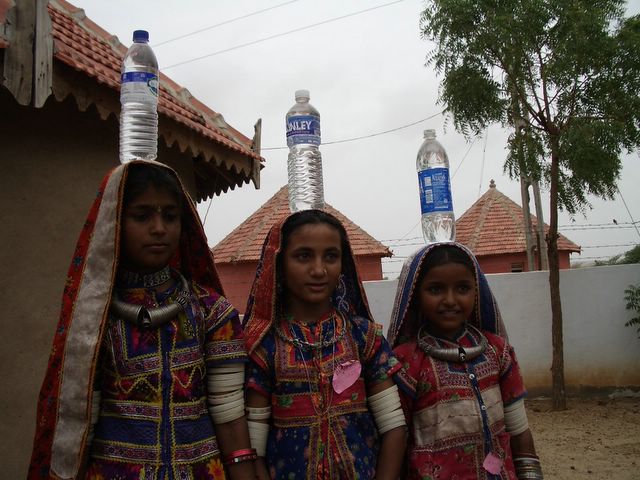
these girls turned up behind me with the bottles atop their heads (they usually carry multiple pots of water)  Posted by Picasa

neo-orientalism at its finest Posted by Picasa

Of tortoises and desert rain

It struck me long ago that age, like time, is relative. Many people I have met in India do not know how old they are; many women become mothers at a time when I would perceive them to still be in their childhood. I understand that seeing ‘age’ as a milestone for life is oftentimes a very western way of viewing the world.

But seeing girls as young as 7 precariously balancing pots of water a few times their weight atop their heads, swathed under layers of ornate clothing and bedecked with heavy jewelry, all in the soaring desert heat, left me speechless. In the lines that crisscrossed their small faces, in the precocious worry that shone through their eyes, I could sense that their concerns were far graver than anything I had ever thought about as young child. Though I am aware that far too many children across the globe have to shoulder ‘adult’ responsibilities at a young age due to financial necessity, it grabbed at my throat to see these little girls looking and acting like miniature versions of themselves 20 years into the future.

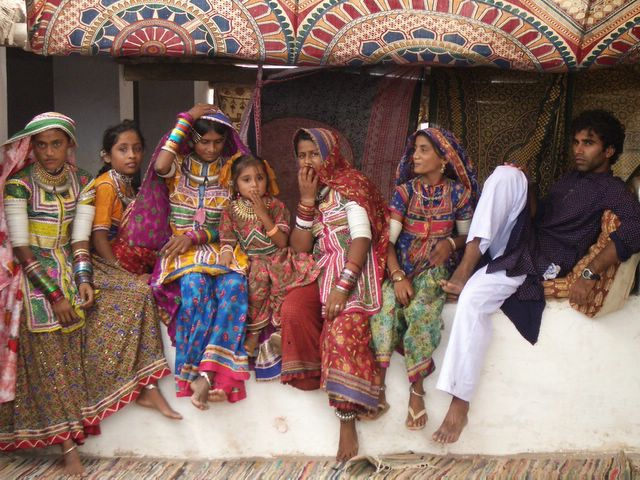
I was in Kutch last weekend for an exhibition of the Rural Design School in the village of Ludiya. The region of Kutch (which comes from kachbo, which means tortoise), due to its proximity to the Indo-Pak border and its unique geographical terrain, has maintained a distinct cultural flavor. The embroidery and woodcarvings of the region have received acclaim throughout the world for their intricacy and striking designs. The embroidery of the region, in particular, is of high artistic merit; generations of girls begin to embroider from a young age in order to prepare a large dowry collection for their weddings. (clothing similar to what they are wearing in the photos)

With its customs and traditions having been largely untouched over the last hundreds of years owing to its geographical isolation, Kutch has in recent years seen a sharp inflow of tourists looking to see an idealized ‘picture of India’. The tourism industry has had a negative effect on, amongst other things, the artwork of the region. Where once women embroidered using their creativity and skill, many now have begun producing inferior quality pieces purely for commercial purposes. This had the effect not only of undermining the work of women who had the talent and inclination to create high-quality pieces, but it also began to deprive women of an important – and perhaps the only -- outlet for themselves.

The Rural Design School was started in 2002 as a joint project between Indicorps and an NGO called Manav Sadhna “with the goals of helping the women build confidence, find their voice and use their own lives as the inspiration to create their own style of embroidery.” Though the project has waged countless uphill battles over the course of its existence mainly due to resistance from village men, in recent times, many village men and women have begun defying custom to support it as they see that it is in their best interest. (A woman was slapped by her father-in-law for wanting to leave the home for the day to showcase her goods at the exhibition; after he left her house, she braved the journey and made it to the exhibition).

While walking with two young girls (in picture) to the water pump one morning, I tried to muddle my way through the thickets of GujaratiKutchi to understand what their chatter was about. It seemed centered around food, family, siblings, and water. They were probably going to go back home, help with the cooking, care for their siblings, do some embroidery, and wait for the next day to come.

These girls probably don’t go to school, and probably never will. Like many women across the world, their opinions, thoughts and ideas will probably forever stay confined within their heads, manifested only in the care with which they do the cooking, the care for their homes, extended families, and children. Embroidery, however, might give these girls a chance to explore their creativity, share their skills, and gain some financial independence.

When I think of how many women across the world are silenced either overtly or covertly by factors beyond their control, I’m grateful for initiatives like the Rural Design School. For it's initiatives such as these which remind me that even when stifled by the heaviest of hands, our voices can still shine through.

Thursday, May 26, 2005

The Power of Being

One of the first things I wanted to do when I moved back was go to Mrs. Singh’s place. I remembered the peace of those very early mornings during high school, when my sister and I would dutifully make our way over to her house for yoga classes. I was awestruck my first day there: here was a woman in her late 50s, who had the body and physical power of a very fit 20 year old. She would lift men and women who were 4 times her size, fold her body in ways that didn’t seem humanly possible and had not a grey hair to her head.

Quite a few years later, I was back last week. Over the last few years, I’d been starting to feel parts of my body wearing down unaccountably, and felt that an attempt at internal rejuvenation was in order. A knee pain here, arm-pain because of computer use,etc. I asked her if I could join up again, and she told me that I would have to come at 5am; she just had no more space. Before I left, she asked, “Any problems?” I looked at her and shook my head; I was embarassed to admit that at 23, I probably had more ‘problems’ than her. In the less 10 days that I’ve been going, I’ve felt some astounding changes. My knee pain is much reduced, the severe allergies to the pollution/dust that I’ve had has decreased tremendously, and I feel a lot more flexible and energetic. Who knows, it might all be psychological, or have to do with other positive lifestyle changes, but I’m hooked.

Though in her early sixties, Mrs. Singh still has no grey hair. Her hair is lustrous, thick, and black. No dyes, no coloring, nothing. (She took one look at my hair and shook her head sadly. “Girls these days, what they do to their hair! All these pantene-vantene chemical shampoos and all.”) She’s wonderfully fit, nimble and radiates energy. She revealed yesterday morning that she actually got into a minor accident and fractured her arm last week, but she refused to treat it or stop doing/teaching yoga, and it has completely healed itself since. Wow.

The philosophy of yog (which means “to unite”, as in uniting of our mind and body) is an interesting thing. The science behind the yogasanas (different postures) involves channeling blood flow to particular areas. My mom, currently in the process of finishing a year long naturopathy/yoga course, explains it thus: “Our organs are like a sponge. When we do an asana (pose), we are ‘wringing’ it. When we release the pose, the blood pours in.” There’s breathing and stretching of various key muscles involved as well, and a host of other things that go into the the true practice of yoga. So it’s not only about the asanas; diet change is a huge part of the therepeutic process. My mom’s professors have stories that are nearly unbelievable. One cured himself, through yoga and naturopathy, of brain cancer. Another’s guru, eyes closed and in lotus-pose, was able to move himself in an arc, 10 feet ahead. The number of people who’ve come to her naturopathy center and have been cured of diseases that medical science would consider impossible to cure, are countless. Mrs. Singh herself began to seriously practice yoga after being diagnosed with an incurable blood disease 32 years ago.

I’ve always enjoyed outdoor sports, and have never really thought twice about their benefits. I’m beginning to rethink that; running, as I’d found, is great for certain parts of the body, but not so great for others. My mom’s center recommends that people combine yoga with brisk walking for exercise. When I first heard that a few months ago, I admittedly thought it was hogwash, and refused to give up running. How can yoga be better for the heart than running?

Now, having taken up yoga with a more open mind-frame, I realize that I’m an impatient person in an impatient world. Sitting in a posture that makes you twist parts of your body you didn’t know existed, for more than two seconds, is not an easy task. I find myself getting impatient after a few seconds, and have to try hard to still myself into keeping the pose for at least 2 minutes. Yoga is hard because there’s no constant stimuli, there are no distractions. It’s just you and your breath. It takes physical and mental stamina, inner strength, and the willingness to be with your body.

There’s a lot of things that science can’t explain about yoga. However, I’m beginning to believe more and more in the unseen power of the universe, and the extraordinary powers of our minds. Physical fitness aside, I think yoga has a far more powerful lesson to teach: the power of being still, the power of just being.

Thursday, May 19, 2005


Vannla, the fruit-seller, and two neighboring girls who popped in Posted by Hello

Chez Kamatchi

The fruit-seller near my house, whose picture stands above (I'd also mentioned her in the Piece of Cloth post below) invited me to her house for lunch one day last month. It was definitely a highlight of Chennai-times. Here's the scoop:

*********
At 11 sharp, Murali, her 15 year old son (and the subject of one of Rahul's posts) rang my doorbell to pick me up. We walked towards their home, and I asked about his exams. “Science only is left”, he said. What did he want to do after 12th? “College”, he said matter-of-factly. And after that? “Computer-job” was the confident reply. Did he have a computer at school? Vigorously nodding, he said that there was in fact, a computer in his corporation (government) school.

By this point, we were nearly at the entrance of their compound, and I quickly navigated my way through the intense alley-way cricket match, watchful for any stray cricket balls whizzing past my head. People, life, dogs, vegetables, kodoms, vigorous water-pumping…it was a cacophony of strident smells, sounds and randomness, but it felt alive, and warm.

We walked upstairs and I saw the tiny, one-roomed apartment had been swept meticulously for the occasion. Kamatchi (the fruit-seller's niece), her lustrous black hair fully-oiled and in a tight bun, face covered with some kind of a mud mask, came out in the suit I had given her. She looked stunning. Another’s riches indeed…She graciously asked me to sit down, and I could see the food carefully placed in the vessels next to the seating-mat she had placed for me on the floor. Clearly, she had made preparations for my arrival. I continued standing, taking in the life exuding from the walls of the 8 by 4 foot space. One wall was covered entirely with neon-lit photos of gods, to its corner was a collection of family photos, each one precious and carefully kept. She entreated me to take a seat, and I sat down, genuinely feeling comfortable and warm in the presence of such hospitality. She brought out a set of three leaf plates, and slightly apologetically, asked if it was okay that we ate on those. I quickly assuaged her fears, and she took mine aside, gave it a quick rinse and set it on the floor in front of me. In a second, she had stepped into the kitchen and brought out a bowl and a tumbler with water. She asked if I would wash my hands, and as I stood up to go wash it, she indicated that she had brought out the bowl for that purpose. Her thoughtfulness blew me away yet again. She poured out a big helping of rice, porriyal and sambar, and brought out 2 apalams. I had to cover the plate completely with my hands, desperately trying to say “poddum!” (enough!); she just continued to give me more, saying that I needed to eat and get healthier. This hospitality, this finesse – from a girl exactly the same age as me.

We began talking, I was curious to hear about her thoughts on marriage and men. She had mentioned to me earlier that by this December, she would definitely be getting married. So why did she want to get married then? “Mother, father, brother – all will be more peaceful then.” But what did she want? She repeated a similar answer, something about how it was the right time, and I realized, that it was really just that. I don’t think she even thought about possibilities otherwise. Did she like children? Her beautiful, smile again appeared, and she said that she did. Both girls and boys? “Both.” What about love marriage, what did she think of that? With the look of distaste that only Indians can express (it’s like – the face you make when you encounter a big, white slimy slug) she said, “love marriage I don’t like. Here, many are having love marriages, but in village only few. Here the men will say they love and marry, but then they will leave the woman.” What did she want in a man? Her answer was delivered with a shy smile, with the hint of a blush, “Drinking, smoking…don’t want. Someone who is honest and good, that is all.” I knew I couldn’t evade her turning the question on to me, and soon she asked. Did I want love or arranged marriage? I was hesitant to tell her that I really didn't know if/when I would get married, so I said I wanted a love marriage, and her eyes opened wide with the flickering of mischief. “What, you want only love marriage, vaa? Now, neeng love pundreenge vaa?” (Now, are you doing love?) I tried to brush off these sorts of questions, but said that marriage would only happen later, I didn’t know right now, but probably 28 or 29. “For us, 28 and all, that is too late.” No preaching, no sermons, no ‘what-the-hell are you talking about’. She understood that we have different ways of living. This was an acceptance of humanity at its best.

But did she want to work? Did she ever go out? What kind of work, she asked quizzically? It was obvious she knew very few unmarried women who worked, and had no idea what kind of a job she could do. A little ruefully, she said that she would want to, but her younger brother and parents were dead-set against it. How did she get to be in this flat, with her aunt, brother and nephews? What did she do here? (6 of them slept in that tiny space). She recounted the story: after her aunt’s husband died, her mother asked her to come out there to help her aunt, who was having a hard time earning an income and taking care of her three sons. So she and her brother (an auto driver) came. She washes the clothes, makes the food and does all the household chores at home. They don’t let her go out too much. And her brother, what about him? “He doesn’t give any money, its chitti who gives it all -- for the food, the gas, the electricity, everything. Sometimes, he gives 10 rupees, but mostly, nothing at all. She’s a good woman, my chitthi, I really like her.”

I had finished with my food about 5 minutes before, and as I looked down at the plate, I realized that an army of ants had already arrived, ready to clear up whatever I couldn’t get at. (I thought about my own complaints about the few ants lying around in some far-flung corner of my apartment..) She again reached over to wash my hands with the tumbler-water. I thanked her profusely, and stood up to walk out. I made as many comments as I could about how wonderful her food was, what a great job she did taking care of them all, and how good she looked. I walked out and said thank you, to which she responded shyly with “thank you, thank you, please come again”, and her 1000-watt smile.

I think of all the dinner invites I’ve received and have given, and I wonder if any have touched me more than this. It’s so true that when truly giving, it doesn’t matter how much you have in your hands or pockets. True giving comes from a place where the waters run far deeper.


Sunday, May 15, 2005

Back

Khatte-meethe phalse, kale-kale phalse,Thande-thande phalse, achche-achche phalse
Phalse-phalse kaleeey, kaleeeeey...
My first thought was that the rich, mahogany baritone resonating from the scorching street below my house was that of a snake-charmer or itinerant sadhu. Charlatan or not, the man’s voice was mesmerizing. I asked Mamta, our polio-afflicted maid, who the person was. After a brief moment of bewilderment, a smile spread across her face. (Only these phoren-people would wonder about something like that) In Bengalied Hindi, she told me that he was just a blackberry seller on his bicycle. With her traditional gait -- back-bent, hand upon knee -- she slowly limped out, still smiling. I looked out over the balcony and saw him, white-turbanned and tanned, slowly moving through the streets. This man, I thought, has made a rational decision about his attitude towards his chosen career. Like most other fruit sellers, he could sit quietly at a stand. Or he could cycle through the seats, shouting “Phalse!” in a shrill monotone.
Yet, he has chosen to sing.

*******************
After my recent Western inundation, which consisted of a whirlwind of US cities combined with a taste of Oxfordian England, I debated taking up blogging again. Far-flung friendships revisited, I realized that it has been a good way to keep conversations going. So I’d like to give it a go again..
My apologies for being incommunicado for a while, have just been trying to get back into the swing of things here. A little on what I’m up to now.. For reasons involving a summer heat-induced household menagerie (I had the privilege of witnessing an epic lizard battle on my bedroom wall), general annoying apartment maintenance issues, and a growing sense of isolation in a family-oriented society, I’ve moved from Chennai to Delhi. I won’t bore you with the challenges of moving back in with the ‘rents since I’m sure you all know what I’m talking about. But I’m actually looking forward to hanging out with family and getting to know this part of the world better. As for the future...plans are still brewing, but my current thinking is to quit my job at the end of June. In the months after that, I plan to apply to grad schools, learn naturopathy, and make it over to Ahemedabad and Manav Sadhna for a couple of weeks. (Rahul, who fortuitously passed through Delhi en route to Thailand yesterday, has left me convinced that it’s the place to be). And as for my next job..am still thinking about it. Recent interviewing experience at a consulting company hasn’t convinced me that it’s the thing for me right now. I’m not sure what the future might hold, so I’m not ruling anything out at the moment. With some exploration, I hope I’ll chance upon something I enjoy. But for the moment, there seem to be too many mountains to climb, books to write, and sunsets to catch before I strap myself into another 9-5.
******************
As to this blog, I don’t know how often I’ll write, I’m going to see how things go. I’m hoping to use it as a forum for thoughts, ideas, and for profiling people/things that inspire me, so write in if you have something to say, would love to hear your thoughts. Lastly, a shoutout to friends across the globe who -- despite oceans, time, busy work/school schedules -- took the time out to meet with me, inspire me, scold me and shelter me at some point in the last few weeks...love you all!


chitraveena extravaganza Posted by Hello

will miss those banana leaf meals Posted by Hello

Wednesday, March 16, 2005

From School to School

“D.A.V Girls Senior Secondary School”, the sign read. Though the street landmarks had changed over the years, I knew this was the right place. I hesitated by the entrance gate, then slowly made my way inside. A cacophony of chattering girls, with bright white-and-grey ribbons and jasmine flowers in their hair, stopped their game of hopscotch midway to take a better look at me. I took in the familiar sights, and little by little, the memories started snaking their way inside my head. The gigantic old Banyan tree, under whose protective cover we'd “hang out” before the morning prayer. The once-detested gray-and-white salwar kameez uniforms, the dupatta of which served as a fan/handkerchief in the scorching summer heat. I quickly ducked as I spotted my SUPW* teacher, from whom I’d received far too many scoldings. As I walked through the courtyard, catching a waft of the “rotten eggs” smell from the Chemistry lab, the once-detested havan** room became visible. The voices, the laughter, math consternation, Chennai slang, all came rushing back.

I didn’t think I would ever be back to my old high school, but there I was. Clutching my purse tightly for comfort, I carefully made my way through the maze of students. I was a good student, but quite a troublemaker, so I wasn’t quite sure how my principal would react to seeing me.

An email had sparked my interest in Goonj’s School-to-School program. After reading the email, it struck me that after many years, I was actually in the same city as a high-school that I had attended. It seemed almost fortuitous: why not try and get the program started here?

I walked up outside my principal’s office, and mentioned to the attendant that I wanted to meet her. A faint flicker of recognition passed across her face; I was an ‘old student’, wasn’t I? She walked inside, and after a few words with the principal, she ushered me in.

LC, we used to call her. There was a time when her booming voice, the imposing manner, the well-oiled, long braid, the characteristic big glasses framing the dark, intelligent eyes, would send shivers down our spines. Would she reject my proposal outright?

I walked in, and smiled. She was a little more wrinkled, a little more grey, but otherwise she looked exactly the same. We chatted briefly about the past, and then I discussed the project idea with her and showed her some reading material on it. Meticulously, she scanned the information on every sheet. Looked at every photo of the villager children, read every caption. With no sign of emotion on her face, she looked up, and asked some questions. “How far is the village you propose to send the items to?” “How you would ensure that the items reach the right people?”

With as much conviction and confidence as I could muster, I told her that I would ensure that the material reached the right hands. (The collected items will be going to an amazing Model Village project, which I've profiled here.) It was strange, I had just finished delivering my first company sales presentation that morning, yet the convincing, the arguments to be made “to sell” this proposal were on different level here, and meant something more to me now.

She looked up and said solemnly, “Even if we can make a 10% difference to the lives of children, it’s worth it. Kids should understand that what they don’t need, they can give away to children just as themselves. In fact, since the village is so close by, after the project is implemented, we might even be able to make a school trip down there so the kids can see for themselves.”

And after all these years, I finally realized what I was here to learn. Under the stern demeanor, the cold stares and the eyes that could bore into you..under her aura of steel lay a wellspring of compassion.

******
I don’t know how change happens, but I know it starts small. It can start anywhere -- from your backyard, from your old high school. I'm not sure how the project will turn out, but I know it’s worth a try.

(If all goes well, the collection boxes will be at the school probably on April 11th , 13th and 15th. I might need some help with the sorting and packing of the collected items. If you’re in the area and would like to help out, drop me an email!)
*SUPW: I can’t even remember what it actually stands for, but it is nationally recognized as “Some Useful Period Wasted”. It is a class to imbibe important vocational skills (i.e. sewing) to girls. We actually had to make slips, blouses and -- don’t laugh -- underwear. I mean, you never know when you’ll be forced to sew your own underwear, right?

**The school’s acronym stand for Dayanand Anglo-Vedic school. The principles of the school are drawn from the Vedas. Every alternate Saturday we had a havan session. In the presence of a central fire, where a “chosen” student would be administering holy offerings into the fire, we had to recite the entire Bhagavad Gita. For those of you who were wondering, this is where I crafted my artful ‘sleep-while-sitting’ technique.

Wednesday, March 09, 2005

A Shot of Spirituality

I walk into a store in the vicinity of the hotel, and the selection -- a far cry from the standard Indian fare -- astounds me: bottles upon bottles of hair dye. Stacks of toilet paper. Rows of cosmetic apparel, each with its own superlative for “natural”. Packs of chocolate chip cookies, boxes of cereal, plastic-encased museli bars, and “natural” honey, strawberries, aloevera toe-cream..you name it. Outside the shop, I see two red-robed figures standing unceremoniously close. The tatooed, pierced man is wearing more beads than my grandmother owns, the bindied and kajaled woman is covering her naked shoulders and head by an outrageously bright dupatta. In foreign tongues, they are trying to get their message across. One says, “I like, I know you, I like, I like…” while the girl, pointing her finger at his chest, says in an equally thick accent, “I like you, you I….”
I feel like I’m in Willy Wonka’s crazy neverland. Well, I almost am. I suspect that there are few places in the world that come as close as Osho-world.

*************
Purely by chance, the hotel my colleague and I were staying at in Poona ended up being right next to the Osho International Meditation Resort. I arrived late on Sunday night on the hotel premises, only to find myself enshrouded in a ring of smoke and amongst a throng of dredlocked red-robed white-folk, who were sitting and lying comfortably close on the ground. With the hint of a snicker, the driver said, “Madame, Barista is here no, so this is only the place where all Osho people are coming.” The scene bewildered me, and I was almost tempted to find out more, but it was late, and the scene too strange, so I decided to call it a night.

The next day, 4am was heralded by “Om Hari Om” devotional songs, courtesy our pious neighbors. I left the hotel early, but was back by noon. Walking to my room, the bass-beats of a trance song greeted my steps. As I drew nearer, I realized that this wasn’t an unusually loud chanting session. There was a disco party happening somewhere. A disco party, at noon?! Straining to get a better glimpse through the grills, I witnessed one of the strangest sights I have ever seen: hundreds of red-robed men and women, were gyrating wildly to the rhythm, their heads swaying as if in a drunken stupor, their arms and legs moving as if by an invisible force. What was more, Osho had apparently ‘forgotten’ to lay down rules on the design of the robes, so interpretation of the design was limited solely by one’s imagination. In fact, if there actually was a dress-code, the spaghetti-strapped, tight-fitting, slitted robes that most women wore seemed to indicate that it was probably “Leave Nothing to the Imagination”.

I needed to get to the bottom of this, and find out if there really was something profound to this popular path to spiritual solace. The skin-showing, the strange dancing..it was all a bit weird, but I was willing to give it the benefit of the doubt. So I decided to take a walk over to the Resort to see for myself.

In the distance, I saw a couple -- man with fountain-like ponytail on top of his head, perfectly-manicured woman wearing a 'robe' that Nicole Kidman would envy -- locked in a frozen embrace near the entrance. A spiritual game of Freeze? I walked over to the entrance desk, only to be waved off by an irate desk attendant, similarly red-robe-clad, who was rolling his eyes at someone on the phone who was enquiring about rooms at the Resort. He thrust me a brochure and waved me to the side.

Brochure in hand, I stood on the side to get a better glimpse of Osho-traffic and to read what all this was about. Pearls of Osho wisdom lay triumphantly on the cover:
“What I am doing here is very simple, very ordinary, nothing spiritual in it, nothing sacred. I am not trying to make you holy persons. I am simply trying to make you sane, intelligent, ordinary people, who can live their lives joyously, dancingly, celebratingly.”

Hmm. I looked up, and chewed on my lip for second. The last time I checked, ‘dancingly’ and ‘celebratingly’ didn’t appear in my dictionary. Well, I thought, so what if Osho wasn’t the brightest star in the sky. I then opened the brochure only to find that visitors were only allowed on a Silent Tour between 9:30 to 11:30 am, and from 2 to 3 pm, for a cost-effective Rs. 10. Bookings a few days in advance were recommended. On the next page, I glimpsed the Meditation section, and was impressed. Maybe there was something to this after all. A second later, I did a double-take as I read the registration procedure:
1. AIDS test, Welcome morning and first day entrance fee. Nationals: Rs. 460; Internationals: Rs. 1180.

An AIDS test?

Enough said.

****************
I’ve wondered about people who come to India to “find themselves” while hopping from ashram to ashram, or who attempt to ayurvedayogamassagereiki their souls to spiritual perfection. Somehow, as the popularity of Osho’s Resort indicates, many want a spirituality that is not spiritual. Something extraordinary that’s ordinary. Something to justify, even encourage, profligate habits. We want someone to tell us that what we seek lies outside, to save us from the difficult task of looking within ourselves.

Of course, I understand that each of us wants to be the best that we can be. But at the cost of leaving a mountain of waste in one’s wake? During the course of my travels, I have met many who, having taken innumerable yoga classes at a lavish Goa/Varkala beach resort, praise the beauty of “my land” and ask me wonderously to elaborate on “my culture”, all the while reaching for a plastic-encased croissant and sipping a plastic cup of Barista coffee. In situations like these, I brush over a few points about my experiences in India, but usually make it a point to hint at the plastic bottle-saving tactic of drinking fresh fruit juice, or encourage people to try local, fresh fare both to encourage local industry and to minimize waste.

This is not to say that Indians don’t waste. But on average, an Indian lifestlye is usually far more resource-efficient than a Western one, usually driven by necessity and habit. I have usually made a quick but polite getaway from conversations such as the one above. But I think I’ll be more truthful next time someone asks. Maybe I will say:

India is indeed one among the most beautiful lands.
But if you want to help preserve it,
Do away with the plastic bottles and toilet paper,
For the power is in your hands.

Sunday, March 06, 2005

Home

There was a time in college when I used to dread the h-word. As exam-fevers subsided and the excitement of break would inundate the campus, some well-intentioned friends would inevitably ask, “So Smita, when are you going home?” My skin would prickle, a shadow of sadness would flit cross my face. Recovery came quickly, however, and I would mask my disconcertedness with a series of rhetorical questions on the semantics of the word “home”, attempting to prove the complexity of a word that seemed so simple to some, yet bottomless, deep, unanswerable to me. Was it a place where you recognized every house for miles beyond your own? The place where your family and friends lived? The place where you first fell in love? The place where you loved the smell of the earth, knew the rhythm of life, and felt so completely you?

Home meant many things to me, yet no one place ever could fit the definition. Having moved around alot as a child and adolescent, each place was ‘home’ to me in its own way. I used to feel that my body had been dismembered, leaving parts of me in every place that I had ever lived in. What’s more, I realized that moving around so much had made travel an inseparable part of my life, and I began to travel even more. I enjoyed it -- still do! -- but wondered if there would ever be a place I could call home.

Gradually, it dawned upon me that moving around hadn't left me ‘incomplete’ or any the poorer. Instead, I realized that I had planted a tree in every place that I had lived in; a tree that could cast its protective branches and provide shelter whenever I chose to be there again. In short, it was not that I had “a home”, but that I had many.

Today, while zipping through the racks for a salwar kameez for an upcoming business trip, I picked up a suit, held it up, and my vision immediately fell upon a familiar face in front me. We stared at each other for a few long seconds, and I slowly ventured, “Meera, I can’t believe it’s you!” We were both stunned at inadvertenly running into each other, more than 7 years since we’d last met. Meera and I had been classmates and good friends in our Chennai high school, yet we had lost touch with each other after I moved away.

I was still reeling as I stumbled out of the shop. I know that there are few places in the world where this could have happened, where I could walk into a shop and chance upon someone who’d known me at a pivotal time in my life. It was a warm, comforting feeling. For the first time in a while, I felt like I was truly home.

Wednesday, March 02, 2005

A Piece of Cloth

I had the good fortune of meeting Anshu Gupta of Goonj a few days ago. In a matter-of-fact manner, he spoke of Goonj’s ingenius urban-waste recycling programs, including the School-to-School program, which has recently won the Changemakers Innovation Award for its excellence. The program involves a partnership between a privileged urban school and a rural school, in which students from the urban school give their rural counterparts school paraphernalia that they would normally have thrown away. Goonj’s philosophy revolves around a widely-known but seldom-implemented philosophy: one person’s rags can indeed be someone elses riches, especially in context of India's gigantic urban-rural divide.

Showcasing the variety of handbags, rugs and pouches made by donated clothes, Anshu briefed me on the importance of cloth. Cloth, Anshu stressed, is one of three basic necessities for humankind, yet few NGOs or government agencies give it too much importance. “We document the number of people who die of floods and of earthquakes. Yet how often has the government ever counted the numbers who die -- mind you, preventable deaths -- of the cold everyday during Delhi’s winters?”

Without blinking an eye, he continued. “Women need a cloth for five days every month. I have travelled far and wide across India, and the situation is the same. Since it is considered to be pollution, women use the dirtiest cloth in the house. Something that’s been used to clean the floors, the bathrooms. And because it is imperative that the cloth be hidden from the neighbors, the cloth does not ever see the light of day. Furthermore, there are usually 2 or 3 women in a household. They all use the same cloth.

“And in this context of shame, of extreme health-risks, we often overlook this reality and give them lectures on reproductive health, maternity care. We still have a long way to go, but providing some clean cloth is a great first step.”

I was flabbergasted. I had no idea that this was the situation that millions of women had to deal with, simply because they were women. I admired the empathy of this man who not only was sharing this with me and the world, but who had taken it upon himself to address this issue.

I remembered the times when I would travel to India as a young girl, and I would see female relatives sleeping on the floor at night. I’d see them banished from the temple, the kitchen -- from touching anything -- during these days of “pollution”. I couldn’t figure out why. Years later, when I finally understood, it made me angry that people could consider women as less-than-humans during this time, that people could scorn the very substance that had given them life. It still makes me angry, but as Anshu reminded me, there’s always a first step.

Yesterday, I befriended the fruit seller down the street and asked her about her family. A beautiful smile lit up her tired face as she told me about her three young sons, all of whom she has been able to put in school. With sadness, pointing to the photograph on her stall, she told me about the death of her husband. At the grocery store today, I got her a soap and some dal, both of which she will probably use mainly for her children. I was just about to leave the store, but I turned to get something I had forgotten: a piece of cloth, for her.

Monday, February 28, 2005

Full Circle

Transatlantic, cross-continental, virtual relationships. I never believed they would work for me. Yet over the course of five months (and it was only after the third that we met!), spanning 3 countries, we’re still going strong.

I met Mark and Yoo-mi for the first time, face-to-face, two months ago. Though we’d only known each other through email, our meeting seemed merely a continuation of our friendship. Countless adventures and steaming roadside thalis later, it’s hard to believe they’ve left.

Flashback November ‘04. New as I was to Chennai, it was a little daunting to begin settling in and forging friendships anew. (Less easy than Shanghai, where you could hop into a Starbucks and get bad food but meet interesting people. At Chennai’s Murugan Idli stalls, however, excellent food but…) Yet three weeks into my stay here, I was in Madurai visiting Pavi and it was as if we'd always known each other. Soon, Rahul, Mark, Yoo-mi and Viral came by, bringing with them a little wisdom, more craziness, and a gigantic amount of California CF cheer. I can hardly think of anything as fortuitous as landing up here with an already-established network of great friends.

On Saturday, Mark, Yoo-mi, Rahul and I met up with my Chennai pals Archana and Kiruba -- only India's No.1 blogger -- over an inspiring meal at Annalakshmi. (Pictures at www.kiruba.com.) Though admittedly I was a bit nervous about the Chennaiers-meets-crazy-San Franciscans dynamics, it was a blast, despite the occasional provocative Mark-isms :) (And Kiruba, the way Rahul pronounces your name, I can’t tell whether he’s referring to an island in the Bahamas or…) In just a few weeks, a Penn college pal and a fav travel-pal will be coming to town to visit this corner of the world.

I love it when worlds and people collide, distances shrink, and time becomes simply a matter of one's perception.

It’s beautiful when life comes full circle. Especially when you least expect it.

Monday, February 21, 2005

A Journey to Remember

The latest wave to hit Chennai’s shores was the Chennai Marathon ’05 on Sunday, February 20th. Kiruba, Jacob and I were absolutely pumped up before the d-day, meticulously keeping track of what to eat, the route, etc. In spite of all these attempts to keep myself primed before the actual race, my knee decided to pull an arthritic cramp on me the week before, and in Mumbai I was attacked by the worst cold I’ve had in a year. So, did I run? Did I arrive in glory..or on a stretcher?

***********
5:30 am Sunday morning. I was still sniffling, had a slight cough, but I felt significantly better than the day before. I knew I didn’t have to run, but it meant something to me, and I had to do it. So I stuffed some cotton in my ears, packed plenty of tissues in my pocket and scoped out an auto to take me to the beachside Anna Square, where the race would begin. I arrived at the location well in time before the start of the marathon, but was astounded at the enormity of the crowd that had already collected until that point. I hadn’t gotten my number till then, so by the time I actually waded through the crowd, found the table and pinned the number, the announcers were asking runners to take their positions for the marathon.

“Men, the Main Marathon is about to begin. We repeat, the Full Marathon, the Main Event, is about to begin. Take your positions!”

Soon after, it was time for the half-marathon, i.e. the Ladies Marathon, to begin. It is believed that women cannot run a full marathon (or are unwilling to) so we are conveniently denied the choice. I heard the announcers announce, “Ladies and boys, take your positions, the Ladies Marathon is about to begin!” As soon as this was announced, the crowd surged forward in an attempt to catch a glimpse of the women. While at first I was annoyed that they kept calling the full marathon the “main event”, I actually felt sorry for the men after I realized that men who actually wanted to only run the half-marathon, couldn’t do so without some serious damage to their self-esteem.

The whistle was blown, and we were off. Some of the men whistled, and I could hear the strains of some lewd filmsong floating in the salt breeze.

Filmsong or not, the key was to keep going. The first few km are always the hardest for me; after 8km or so I can keep going at a steady pace. At the 6 or 7k point, I stopped to blow my nose. Soon after, I felt someone patting me on the shoulder saying, “Go on, you can do it!” It was Michelle, a wonderful Maltese pilot/newmom whom I just met at the starting line. I couldn’t help but think how nice it was of her to pause her own running to cheer me on. I kept going.

The 10k point was nearing, and I could see a water stop in the distance. Two young boys, both perhaps around 9, were handing out water in cups to runners. “Some water?”they earnestly enquired. When I stopped to fill my own bottle from the water can, they rushed over and tried to foist a cup on me. “Don’t stop, just take this water!” they urged. I looked at them, thought of something to say that would express how thoughtful I thought it was for them to be doing this, especially at their age. I couldn’t think of anything, so I smiled, and went on my way.

The turnaround point came, and the bluish-white waves of the Besant Nagar beach became visible. A group of slum-children, clearly taken aback by the strange spectacle, had seated themselves comfortably on the sandy pavement near the road. They gawked at the runners, pointed, smiled, waved and cheered us on.

15km down, and I knew I could make it. 12-time marathon runner Jacob, who’d been counting the number of girls before me, paused momentarily when he saw me to cheer me on, “Come on, Smita, you can do it, you’re in the *th place now!”
The sun was beating relentlessly now, I was feeling a bit stuffy and I was on a busy road stretch before the finish line. Standing in front of the thatchments of roadside fruit-sellers were some appointed water bearers who were handing out sponges and water. One man caught my eye, and I turned to take a better look. Sure enough, an old fruit seller, in his tattered veshti and muddy shirt, was handing bottles to runners. This man is offering me water, I thought, who probably has no drinking water for himself…

I did finally make it. But when I approached the finish line I realized that my finishing was just incidental to the experience. The beauty, it struck me, was not in the arrival, but in the journey. Lao Tzu sure got it right when he said, “A good traveler has no fixed plans, and is not intent on arriving.”

Monday, February 14, 2005

NASSCOM '05

Many truths sprang forth from this year’s conference. Some snapshots of the three-day extravaganza:

**************************************
Abul Kalam Azad, President of India, renowned scientist and the driving force behind India’s nuclear program, addressed the gathering on the last day of the conference. He had heard of the conference’s ambitious aims to increase India’s share of the global IT pie from 3.5% to 6% by 2009. But he was not impressed. He chastized, “It is crime to under-aim! You must get to 15% in five years, I will give formula!” With this ominous pronouncement, he unveiled a dense powerpoint presentation, filled with numbers and graphs and charts that sent my mind swirling. When the time came for question and answers, revealing his erstwhile Professor status, he barked, “Mr. Mehta. Where is Mr. Mehta? Ask me a question!” Flabbergasted, the software scion loosened his tie and hastily asked a question, and I could see others squirming in their seats lest they be called upon next. Yes, only the President of India could have sent us all back to scary seventh grade days.

**************************************
Narayana Moorthy, esteemed founder of Infosys and the godfather of Indian IT on “compassionate capitalism” and how to be a successful entrepreneur:
a) Need to have an idea that can be expressed in a simple sentence
b) Need a team that is mutually exclusive but comprehensively inclusive
c) Need a value system
d) Essential ingredients are speed, imagination and excellence in execution.

**************************************
McKinsie’s crystal-ball predictions on IT and India:
- Indian global delivery model will continue to gain ground in the world
- Segments like infrastructure (server and network monitoring, data centers) will be looked at for delivery and will begin to move offshore.
- Call centers will become obsolete in a few years as voice-recognition software nears perfection.
- Wage inflation growing tremendously in India; India needs to focus on advantages other than cost in order to maintain it’s ‘poster child’ for IT image

**************************************************
And of course, I have to have My Own boxing g-Love At First Sight Bombay Bollywood Story

I thought I was prepared for the onslaught of NASSCOM ’05 that Tuesday afternoon. Clad in the first western business outfit I’d worn in many months, and with conference pad and shining new pen in tow, I felt I was ready for anything. At the foot of the stairs near the registration desk, I paused and took a deep breath. In a sea of black suits and bulging tummies, I realized it: not only was I fortunate enough to fall into the .5% of the female population there, I also had the distinction of being youngest among the 1200-odd delegates.

It didn’t take long for Mr. Sanjob to register this fact. As I walked away from the registration desk, he gallantly reminded me in his unbecoming Atlanta-twanged Orissan accent, “Miss, you habh phorgotten your complementary bhag.” I looked up to find the origins of this unsolicited remark, and my line of vision immediately fell upon the stomach of an enormous, walrus-like man who was standing stupidly with a toothy grin. “Oh, great, I’ll go get it”, I hurriedly remarked with a half-smile-half-grimace, hoping that he would disappear if I waited at the desk long enough. But, gallant as he was, he waited till the bag was in my hand, and decided to escort me along the hall.
Shall bhee get lunch? he volunteered. As luck would have it, the conference was kicking off with a networking lunch. I was alone, with no fellow colleague who could be used for deflection purposes. My cell phone refused to work, ruling out the possibility of an urgent, phantom phone call. With no exit strategy, I thought: what the hell, what’s the worst that can happen?

Plates in hand, we sat down at the only available “table for two”. After a long description of his company and his life ambitions and goals (a few pointed questions easily broke that dam loose), he said, “so tell me more about you.” I looked squarely at my plate, fumbling to pick up the few remaining pieces of rice. “My life is pretty boring…umm…I like listening to music..wow that desert looks greatI’mgoingtogogetsome.”
Back at the table, he began again. So, Smita, bhat do you like to do with your phree time? I looked down at my plate, searched for remaining edible items, and decided to begin the task of slicing a grape into eighths. In between, I mumbled, “mmm…I like readingwhatdoyoulike to do” With the look of a sage, he said, “I like to travel, but I hate traveling alone. All my friends are married. I hate staying in hotel rooms alone, you know?” Pause. “Ermmmm” I muttered, fully engrossed in the arduous task of fruit dissection. He continued: “I also like to give back to the community in my free time. I’m a member of Atlanta’s two biggest….(blah-blah)..But in particular, I love teaching Children. I just love Children.” A deliberate pause followed, and he looked solemnly at me. It was a 6-star lunch, but I almost felt like throwing up. As I excused myself on account of ill-health, I thought, so this is what a Bollywood film feels like..