One of the first things I wanted to do when I moved back was go to Mrs. Singh’s place. I remembered the peace of those very early mornings during high school, when my sister and I would dutifully make our way over to her house for yoga classes. I was awestruck my first day there: here was a woman in her late 50s, who had the body and physical power of a very fit 20 year old. She would lift men and women who were 4 times her size, fold her body in ways that didn’t seem humanly possible and had not a grey hair to her head.
Thursday, May 26, 2005
The Power of Being


Thursday, May 19, 2005


Chez Kamatchi
*********
At 11 sharp, Murali, her 15 year old son (and the subject of one of Rahul's posts) rang my doorbell to pick me up. We walked towards their home, and I asked about his exams. “Science only is left”, he said. What did he want to do after 12th? “College”, he said matter-of-factly. And after that? “Computer-job” was the confident reply. Did he have a computer at school? Vigorously nodding, he said that there was in fact, a computer in his corporation (government) school.
But did she want to work? Did she ever go out? What kind of work, she asked quizzically? It was obvious she knew very few unmarried women who worked, and had no idea what kind of a job she could do. A little ruefully, she said that she would want to, but her younger brother and parents were dead-set against it. How did she get to be in this flat, with her aunt, brother and nephews? What did she do here? (6 of them slept in that tiny space). She recounted the story: after her aunt’s husband died, her mother asked her to come out there to help her aunt, who was having a hard time earning an income and taking care of her three sons. So she and her brother (an auto driver) came. She washes the clothes, makes the food and does all the household chores at home. They don’t let her go out too much. And her brother, what about him? “He doesn’t give any money, its chitti who gives it all -- for the food, the gas, the electricity, everything. Sometimes, he gives 10 rupees, but mostly, nothing at all. She’s a good woman, my chitthi, I really like her.”
I think of all the dinner invites I’ve received and have given, and I wonder if any have touched me more than this. It’s so true that when truly giving, it doesn’t matter how much you have in your hands or pockets. True giving comes from a place where the waters run far deeper.
Sunday, May 15, 2005
Back
Phalse-phalse kaleeey, kaleeeeey...
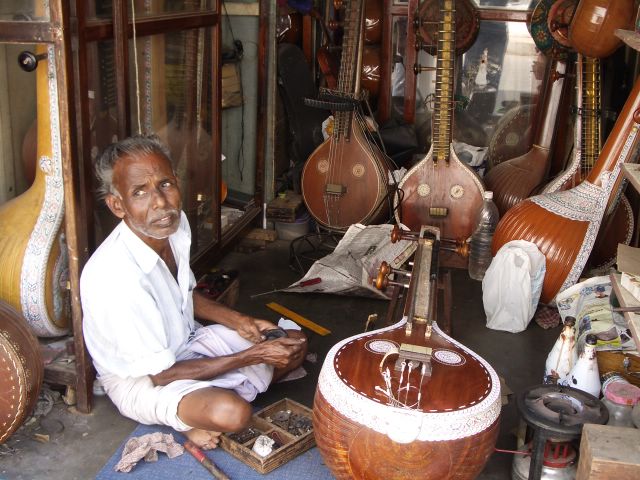
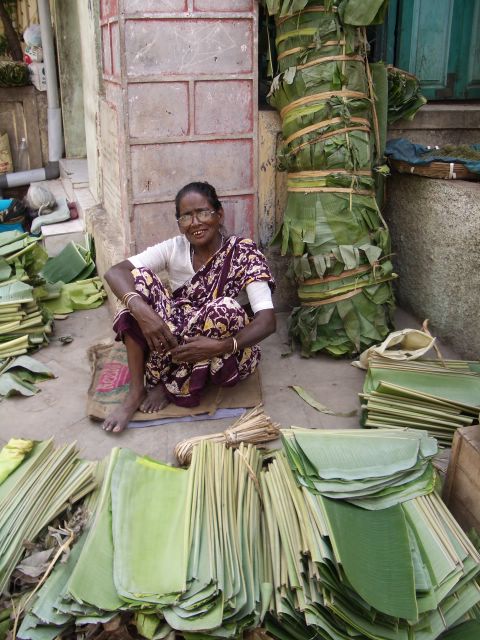
Yet, he has chosen to sing.
Wednesday, March 16, 2005
From School to School
I didn’t think I would ever be back to my old high school, but there I was. Clutching my purse tightly for comfort, I carefully made my way through the maze of students. I was a good student, but quite a troublemaker, so I wasn’t quite sure how my principal would react to seeing me.
An email had sparked my interest in Goonj’s School-to-School program. After reading the email, it struck me that after many years, I was actually in the same city as a high-school that I had attended. It seemed almost fortuitous: why not try and get the program started here?
I walked up outside my principal’s office, and mentioned to the attendant that I wanted to meet her. A faint flicker of recognition passed across her face; I was an ‘old student’, wasn’t I? She walked inside, and after a few words with the principal, she ushered me in.
LC, we used to call her. There was a time when her booming voice, the imposing manner, the well-oiled, long braid, the characteristic big glasses framing the dark, intelligent eyes, would send shivers down our spines. Would she reject my proposal outright?
I walked in, and smiled. She was a little more wrinkled, a little more grey, but otherwise she looked exactly the same. We chatted briefly about the past, and then I discussed the project idea with her and showed her some reading material on it. Meticulously, she scanned the information on every sheet. Looked at every photo of the villager children, read every caption. With no sign of emotion on her face, she looked up, and asked some questions. “How far is the village you propose to send the items to?” “How you would ensure that the items reach the right people?”
With as much conviction and confidence as I could muster, I told her that I would ensure that the material reached the right hands. (The collected items will be going to an amazing Model Village project, which I've profiled here.) It was strange, I had just finished delivering my first company sales presentation that morning, yet the convincing, the arguments to be made “to sell” this proposal were on different level here, and meant something more to me now.
She looked up and said solemnly, “Even if we can make a 10% difference to the lives of children, it’s worth it. Kids should understand that what they don’t need, they can give away to children just as themselves. In fact, since the village is so close by, after the project is implemented, we might even be able to make a school trip down there so the kids can see for themselves.”
And after all these years, I finally realized what I was here to learn. Under the stern demeanor, the cold stares and the eyes that could bore into you..under her aura of steel lay a wellspring of compassion.
******
I don’t know how change happens, but I know it starts small. It can start anywhere -- from your backyard, from your old high school. I'm not sure how the project will turn out, but I know it’s worth a try.
(If all goes well, the collection boxes will be at the school probably on April 11th , 13th and 15th. I might need some help with the sorting and packing of the collected items. If you’re in the area and would like to help out, drop me an email!)
*SUPW: I can’t even remember what it actually stands for, but it is nationally recognized as “Some Useful Period Wasted”. It is a class to imbibe important vocational skills (i.e. sewing) to girls. We actually had to make slips, blouses and -- don’t laugh -- underwear. I mean, you never know when you’ll be forced to sew your own underwear, right?
**The school’s acronym stand for Dayanand Anglo-Vedic school. The principles of the school are drawn from the Vedas. Every alternate Saturday we had a havan session. In the presence of a central fire, where a “chosen” student would be administering holy offerings into the fire, we had to recite the entire Bhagavad Gita. For those of you who were wondering, this is where I crafted my artful ‘sleep-while-sitting’ technique.
Wednesday, March 09, 2005
A Shot of Spirituality
I feel like I’m in Willy Wonka’s crazy neverland. Well, I almost am. I suspect that there are few places in the world that come as close as Osho-world.
*************
Purely by chance, the hotel my colleague and I were staying at in Poona ended up being right next to the Osho International Meditation Resort. I arrived late on Sunday night on the hotel premises, only to find myself enshrouded in a ring of smoke and amongst a throng of dredlocked red-robed white-folk, who were sitting and lying comfortably close on the ground. With the hint of a snicker, the driver said, “Madame, Barista is here no, so this is only the place where all Osho people are coming.” The scene bewildered me, and I was almost tempted to find out more, but it was late, and the scene too strange, so I decided to call it a night.
The next day, 4am was heralded by “Om Hari Om” devotional songs, courtesy our pious neighbors. I left the hotel early, but was back by noon. Walking to my room, the bass-beats of a trance song greeted my steps. As I drew nearer, I realized that this wasn’t an unusually loud chanting session. There was a disco party happening somewhere. A disco party, at noon?! Straining to get a better glimpse through the grills, I witnessed one of the strangest sights I have ever seen: hundreds of red-robed men and women, were gyrating wildly to the rhythm, their heads swaying as if in a drunken stupor, their arms and legs moving as if by an invisible force. What was more, Osho had apparently ‘forgotten’ to lay down rules on the design of the robes, so interpretation of the design was limited solely by one’s imagination. In fact, if there actually was a dress-code, the spaghetti-strapped, tight-fitting, slitted robes that most women wore seemed to indicate that it was probably “Leave Nothing to the Imagination”.
I needed to get to the bottom of this, and find out if there really was something profound to this popular path to spiritual solace. The skin-showing, the strange dancing..it was all a bit weird, but I was willing to give it the benefit of the doubt. So I decided to take a walk over to the Resort to see for myself.
In the distance, I saw a couple -- man with fountain-like ponytail on top of his head, perfectly-manicured woman wearing a 'robe' that Nicole Kidman would envy -- locked in a frozen embrace near the entrance. A spiritual game of Freeze? I walked over to the entrance desk, only to be waved off by an irate desk attendant, similarly red-robe-clad, who was rolling his eyes at someone on the phone who was enquiring about rooms at the Resort. He thrust me a brochure and waved me to the side.
Brochure in hand, I stood on the side to get a better glimpse of Osho-traffic and to read what all this was about. Pearls of Osho wisdom lay triumphantly on the cover:
“What I am doing here is very simple, very ordinary, nothing spiritual in it, nothing sacred. I am not trying to make you holy persons. I am simply trying to make you sane, intelligent, ordinary people, who can live their lives joyously, dancingly, celebratingly.”
Hmm. I looked up, and chewed on my lip for second. The last time I checked, ‘dancingly’ and ‘celebratingly’ didn’t appear in my dictionary. Well, I thought, so what if Osho wasn’t the brightest star in the sky. I then opened the brochure only to find that visitors were only allowed on a Silent Tour between 9:30 to 11:30 am, and from 2 to 3 pm, for a cost-effective Rs. 10. Bookings a few days in advance were recommended. On the next page, I glimpsed the Meditation section, and was impressed. Maybe there was something to this after all. A second later, I did a double-take as I read the registration procedure:
1. AIDS test, Welcome morning and first day entrance fee. Nationals: Rs. 460; Internationals: Rs. 1180.
An AIDS test?
Enough said.
****************
I’ve wondered about people who come to India to “find themselves” while hopping from ashram to ashram, or who attempt to ayurvedayogamassagereiki their souls to spiritual perfection. Somehow, as the popularity of Osho’s Resort indicates, many want a spirituality that is not spiritual. Something extraordinary that’s ordinary. Something to justify, even encourage, profligate habits. We want someone to tell us that what we seek lies outside, to save us from the difficult task of looking within ourselves.
Of course, I understand that each of us wants to be the best that we can be. But at the cost of leaving a mountain of waste in one’s wake? During the course of my travels, I have met many who, having taken innumerable yoga classes at a lavish Goa/Varkala beach resort, praise the beauty of “my land” and ask me wonderously to elaborate on “my culture”, all the while reaching for a plastic-encased croissant and sipping a plastic cup of Barista coffee. In situations like these, I brush over a few points about my experiences in India, but usually make it a point to hint at the plastic bottle-saving tactic of drinking fresh fruit juice, or encourage people to try local, fresh fare both to encourage local industry and to minimize waste.
This is not to say that Indians don’t waste. But on average, an Indian lifestlye is usually far more resource-efficient than a Western one, usually driven by necessity and habit. I have usually made a quick but polite getaway from conversations such as the one above. But I think I’ll be more truthful next time someone asks. Maybe I will say:
India is indeed one among the most beautiful lands.
But if you want to help preserve it,
Do away with the plastic bottles and toilet paper,
For the power is in your hands.
Sunday, March 06, 2005
Home
Home meant many things to me, yet no one place ever could fit the definition. Having moved around alot as a child and adolescent, each place was ‘home’ to me in its own way. I used to feel that my body had been dismembered, leaving parts of me in every place that I had ever lived in. What’s more, I realized that moving around so much had made travel an inseparable part of my life, and I began to travel even more. I enjoyed it -- still do! -- but wondered if there would ever be a place I could call home.
Gradually, it dawned upon me that moving around hadn't left me ‘incomplete’ or any the poorer. Instead, I realized that I had planted a tree in every place that I had lived in; a tree that could cast its protective branches and provide shelter whenever I chose to be there again. In short, it was not that I had “a home”, but that I had many.
Today, while zipping through the racks for a salwar kameez for an upcoming business trip, I picked up a suit, held it up, and my vision immediately fell upon a familiar face in front me. We stared at each other for a few long seconds, and I slowly ventured, “Meera, I can’t believe it’s you!” We were both stunned at inadvertenly running into each other, more than 7 years since we’d last met. Meera and I had been classmates and good friends in our Chennai high school, yet we had lost touch with each other after I moved away.
I was still reeling as I stumbled out of the shop. I know that there are few places in the world where this could have happened, where I could walk into a shop and chance upon someone who’d known me at a pivotal time in my life. It was a warm, comforting feeling. For the first time in a while, I felt like I was truly home.
Wednesday, March 02, 2005
A Piece of Cloth
Showcasing the variety of handbags, rugs and pouches made by donated clothes, Anshu briefed me on the importance of cloth. Cloth, Anshu stressed, is one of three basic necessities for humankind, yet few NGOs or government agencies give it too much importance. “We document the number of people who die of floods and of earthquakes. Yet how often has the government ever counted the numbers who die -- mind you, preventable deaths -- of the cold everyday during Delhi’s winters?”
Without blinking an eye, he continued. “Women need a cloth for five days every month. I have travelled far and wide across India, and the situation is the same. Since it is considered to be pollution, women use the dirtiest cloth in the house. Something that’s been used to clean the floors, the bathrooms. And because it is imperative that the cloth be hidden from the neighbors, the cloth does not ever see the light of day. Furthermore, there are usually 2 or 3 women in a household. They all use the same cloth.
“And in this context of shame, of extreme health-risks, we often overlook this reality and give them lectures on reproductive health, maternity care. We still have a long way to go, but providing some clean cloth is a great first step.”
I was flabbergasted. I had no idea that this was the situation that millions of women had to deal with, simply because they were women. I admired the empathy of this man who not only was sharing this with me and the world, but who had taken it upon himself to address this issue.
I remembered the times when I would travel to India as a young girl, and I would see female relatives sleeping on the floor at night. I’d see them banished from the temple, the kitchen -- from touching anything -- during these days of “pollution”. I couldn’t figure out why. Years later, when I finally understood, it made me angry that people could consider women as less-than-humans during this time, that people could scorn the very substance that had given them life. It still makes me angry, but as Anshu reminded me, there’s always a first step.
Yesterday, I befriended the fruit seller down the street and asked her about her family. A beautiful smile lit up her tired face as she told me about her three young sons, all of whom she has been able to put in school. With sadness, pointing to the photograph on her stall, she told me about the death of her husband. At the grocery store today, I got her a soap and some dal, both of which she will probably use mainly for her children. I was just about to leave the store, but I turned to get something I had forgotten: a piece of cloth, for her.
Monday, February 28, 2005
Full Circle
I met Mark and Yoo-mi for the first time, face-to-face, two months ago. Though we’d only known each other through email, our meeting seemed merely a continuation of our friendship. Countless adventures and steaming roadside thalis later, it’s hard to believe they’ve left.
Flashback November ‘04. New as I was to Chennai, it was a little daunting to begin settling in and forging friendships anew. (Less easy than Shanghai, where you could hop into a Starbucks and get bad food but meet interesting people. At Chennai’s Murugan Idli stalls, however, excellent food but…) Yet three weeks into my stay here, I was in Madurai visiting Pavi and it was as if we'd always known each other. Soon, Rahul, Mark, Yoo-mi and Viral came by, bringing with them a little wisdom, more craziness, and a gigantic amount of California CF cheer. I can hardly think of anything as fortuitous as landing up here with an already-established network of great friends.
On Saturday, Mark, Yoo-mi, Rahul and I met up with my Chennai pals Archana and Kiruba -- only India's No.1 blogger -- over an inspiring meal at Annalakshmi. (Pictures at www.kiruba.com.) Though admittedly I was a bit nervous about the Chennaiers-meets-crazy-San Franciscans dynamics, it was a blast, despite the occasional provocative Mark-isms :) (And Kiruba, the way Rahul pronounces your name, I can’t tell whether he’s referring to an island in the Bahamas or…) In just a few weeks, a Penn college pal and a fav travel-pal will be coming to town to visit this corner of the world.
I love it when worlds and people collide, distances shrink, and time becomes simply a matter of one's perception.
It’s beautiful when life comes full circle. Especially when you least expect it.
Monday, February 21, 2005
A Journey to Remember
***********
5:30 am Sunday morning. I was still sniffling, had a slight cough, but I felt significantly better than the day before. I knew I didn’t have to run, but it meant something to me, and I had to do it. So I stuffed some cotton in my ears, packed plenty of tissues in my pocket and scoped out an auto to take me to the beachside Anna Square, where the race would begin. I arrived at the location well in time before the start of the marathon, but was astounded at the enormity of the crowd that had already collected until that point. I hadn’t gotten my number till then, so by the time I actually waded through the crowd, found the table and pinned the number, the announcers were asking runners to take their positions for the marathon.
“Men, the Main Marathon is about to begin. We repeat, the Full Marathon, the Main Event, is about to begin. Take your positions!”
Soon after, it was time for the half-marathon, i.e. the Ladies Marathon, to begin. It is believed that women cannot run a full marathon (or are unwilling to) so we are conveniently denied the choice. I heard the announcers announce, “Ladies and boys, take your positions, the Ladies Marathon is about to begin!” As soon as this was announced, the crowd surged forward in an attempt to catch a glimpse of the women. While at first I was annoyed that they kept calling the full marathon the “main event”, I actually felt sorry for the men after I realized that men who actually wanted to only run the half-marathon, couldn’t do so without some serious damage to their self-esteem.
The whistle was blown, and we were off. Some of the men whistled, and I could hear the strains of some lewd filmsong floating in the salt breeze.
Filmsong or not, the key was to keep going. The first few km are always the hardest for me; after 8km or so I can keep going at a steady pace. At the 6 or 7k point, I stopped to blow my nose. Soon after, I felt someone patting me on the shoulder saying, “Go on, you can do it!” It was Michelle, a wonderful Maltese pilot/newmom whom I just met at the starting line. I couldn’t help but think how nice it was of her to pause her own running to cheer me on. I kept going.
The 10k point was nearing, and I could see a water stop in the distance. Two young boys, both perhaps around 9, were handing out water in cups to runners. “Some water?”they earnestly enquired. When I stopped to fill my own bottle from the water can, they rushed over and tried to foist a cup on me. “Don’t stop, just take this water!” they urged. I looked at them, thought of something to say that would express how thoughtful I thought it was for them to be doing this, especially at their age. I couldn’t think of anything, so I smiled, and went on my way.
The turnaround point came, and the bluish-white waves of the Besant Nagar beach became visible. A group of slum-children, clearly taken aback by the strange spectacle, had seated themselves comfortably on the sandy pavement near the road. They gawked at the runners, pointed, smiled, waved and cheered us on.
15km down, and I knew I could make it. 12-time marathon runner Jacob, who’d been counting the number of girls before me, paused momentarily when he saw me to cheer me on, “Come on, Smita, you can do it, you’re in the *th place now!”
The sun was beating relentlessly now, I was feeling a bit stuffy and I was on a busy road stretch before the finish line. Standing in front of the thatchments of roadside fruit-sellers were some appointed water bearers who were handing out sponges and water. One man caught my eye, and I turned to take a better look. Sure enough, an old fruit seller, in his tattered veshti and muddy shirt, was handing bottles to runners. This man is offering me water, I thought, who probably has no drinking water for himself…
I did finally make it. But when I approached the finish line I realized that my finishing was just incidental to the experience. The beauty, it struck me, was not in the arrival, but in the journey. Lao Tzu sure got it right when he said, “A good traveler has no fixed plans, and is not intent on arriving.”
Monday, February 14, 2005
NASSCOM '05
**************************************
Abul Kalam Azad, President of India, renowned scientist and the driving force behind India’s nuclear program, addressed the gathering on the last day of the conference. He had heard of the conference’s ambitious aims to increase India’s share of the global IT pie from 3.5% to 6% by 2009. But he was not impressed. He chastized, “It is crime to under-aim! You must get to 15% in five years, I will give formula!” With this ominous pronouncement, he unveiled a dense powerpoint presentation, filled with numbers and graphs and charts that sent my mind swirling. When the time came for question and answers, revealing his erstwhile Professor status, he barked, “Mr. Mehta. Where is Mr. Mehta? Ask me a question!” Flabbergasted, the software scion loosened his tie and hastily asked a question, and I could see others squirming in their seats lest they be called upon next. Yes, only the President of India could have sent us all back to scary seventh grade days.
**************************************
Narayana Moorthy, esteemed founder of Infosys and the godfather of Indian IT on “compassionate capitalism” and how to be a successful entrepreneur:
a) Need to have an idea that can be expressed in a simple sentence
b) Need a team that is mutually exclusive but comprehensively inclusive
c) Need a value system
d) Essential ingredients are speed, imagination and excellence in execution.
**************************************
McKinsie’s crystal-ball predictions on IT and India:
- Indian global delivery model will continue to gain ground in the world
- Segments like infrastructure (server and network monitoring, data centers) will be looked at for delivery and will begin to move offshore.
- Call centers will become obsolete in a few years as voice-recognition software nears perfection.
- Wage inflation growing tremendously in India; India needs to focus on advantages other than cost in order to maintain it’s ‘poster child’ for IT image
**************************************************
And of course, I have to have My Own boxing g-Love At First Sight Bombay Bollywood Story
I thought I was prepared for the onslaught of NASSCOM ’05 that Tuesday afternoon. Clad in the first western business outfit I’d worn in many months, and with conference pad and shining new pen in tow, I felt I was ready for anything. At the foot of the stairs near the registration desk, I paused and took a deep breath. In a sea of black suits and bulging tummies, I realized it: not only was I fortunate enough to fall into the .5% of the female population there, I also had the distinction of being youngest among the 1200-odd delegates.
It didn’t take long for Mr. Sanjob to register this fact. As I walked away from the registration desk, he gallantly reminded me in his unbecoming Atlanta-twanged Orissan accent, “Miss, you habh phorgotten your complementary bhag.” I looked up to find the origins of this unsolicited remark, and my line of vision immediately fell upon the stomach of an enormous, walrus-like man who was standing stupidly with a toothy grin. “Oh, great, I’ll go get it”, I hurriedly remarked with a half-smile-half-grimace, hoping that he would disappear if I waited at the desk long enough. But, gallant as he was, he waited till the bag was in my hand, and decided to escort me along the hall.
Shall bhee get lunch? he volunteered. As luck would have it, the conference was kicking off with a networking lunch. I was alone, with no fellow colleague who could be used for deflection purposes. My cell phone refused to work, ruling out the possibility of an urgent, phantom phone call. With no exit strategy, I thought: what the hell, what’s the worst that can happen?
Plates in hand, we sat down at the only available “table for two”. After a long description of his company and his life ambitions and goals (a few pointed questions easily broke that dam loose), he said, “so tell me more about you.” I looked squarely at my plate, fumbling to pick up the few remaining pieces of rice. “My life is pretty boring…umm…I like listening to music..wow that desert looks greatI’mgoingtogogetsome.”
Back at the table, he began again. So, Smita, bhat do you like to do with your phree time? I looked down at my plate, searched for remaining edible items, and decided to begin the task of slicing a grape into eighths. In between, I mumbled, “mmm…I like readingwhatdoyoulike to do” With the look of a sage, he said, “I like to travel, but I hate traveling alone. All my friends are married. I hate staying in hotel rooms alone, you know?” Pause. “Ermmmm” I muttered, fully engrossed in the arduous task of fruit dissection. He continued: “I also like to give back to the community in my free time. I’m a member of Atlanta’s two biggest….(blah-blah)..But in particular, I love teaching Children. I just love Children.” A deliberate pause followed, and he looked solemnly at me. It was a 6-star lunch, but I almost felt like throwing up. As I excused myself on account of ill-health, I thought, so this is what a Bollywood film feels like..
Monday, February 07, 2005
Mumbaied
***************************************
They say that if you want a total-body experience of childbirth, you should sit on a suburban train in Mumbai. It’s not so much that you get off the train as much as you are, well, ‘expelled’ by the heaving, shoving masses. So it was with some trepidation that the lady at the hotel reception began to answer my question after I arrived yesterday evening: how do I take the train from Santa Cruz to Churchgate? (you can tell Mumbai used to be a British stronghold). “It’s rush hour….it’ll be too crowded…” For a minute, I was tempted to heed her well-intentioned advice. Only for a minute.
****************************************
An only-ladies compartment “for all 24 hours”, the sign specifies. I hop on the train from Churchgate, back to Santa Cruz, after a long sunset walk on Marine Drive. It’s relatively empty, but by the next stop, it’s packed. A group of Maharashtrian ladies decide to join in, squashing me against two high-school girls in the midst of a heated discussion. Inadvertently, I have become an eavesdropper. I realize that the girl next to me is an expert joke-teller. Each joke is crisply delivered in a practiced monotone, and at the end of each, without even a pause, she moves to the next. “What did one Egyptian boy tell an Egyptian girl at the Giza pyramids?” she says. “Come behind here, and I’ll show you how to become a mummy.” Even before I can shield my ears, she has jumped to the next one. The rising tenor of the group of Maharashtrian women adjacent to me draws me to their conversation. There are two old ladies, and two young ones. Their attention is riveted on one of the younger ones, who, in Marathi, appears to be jumping quickly between topics of religion, recipe-advice and annoying mothers-in-law.
“Cheeeeepssssssssssss.” “Cheeepssssssssssssssss.” It’s the drone of the chip seller, who sounds like he’s taken voice lessons from a snake and an engine. After his fourth round through, I wonder why he’s wasting his time here; nobody’s bought anything yet. Then I watch his strategy. He walks unseeing along, until he gets to the berth of the…erm..heftiest lady aboard. There, he pauses for an extra moment, showcasing his goods. And the 5th round through, sure enough, business has been made.
The train is now so packed that conversationsbreathfeet merge together. A tall, youngish man, with a slew of neon-colored plastic bags, jumps on board. He towers among the women around, droning “Chiiiinaaa bagsss. Chiiina baaags.” Needless to say, he grabs my attention and I turn to take a closer look at the bags. They are cheap, polyester longish bags, replete with neon handles and off-color winnie-the-pooh designs. Who would want to buy…my train of thought is stopped right there, as I see women bending, reaching, straining over to take a closer look and pick the color that their child would want. I turn back around and think of the Indian streets filled with Chinese goods. Yup, India and China are coming closer than ever before.
My stop is approaching, and I’m getting worried. While I’m comfortably seated amidst grandmotherly women and an amusing (though shocking) jokester, I’m worried about my departure. It’s so crowded that I can barely move out of my seat. The train begins to slow down, and I make my way through. Even though the train hasn’t stopped, women have already started alighting, heedless to the attemps of off-bound passengers. Now this, I was not expecting. The force pushing me back inside is getting stronger, yet I try to push my way out. The train has stopped, and I can’t move. I push even harder to get through, stepping on a few people’s toes. The arm clutching my purse has not found it’s way through, it’s stuck. In a final burst, I push again, and I’m out, but I land squarely on the feet of an alighting woman. “Yiiidiot!” she mutters. Oh well, at least I’m out.
A renaissance? Maybe. Who knows what the week might bring? :)
Wednesday, February 02, 2005
Auto-Epiphanies
***********************************
Familiar getting-out-of-auto story: we arrive at our destination, and I only have a hundred or fifty rupee note on me. I’m about to ask if the auto driver has change, but I realize they never do. Invariably, the response I get in Tamil is, “Madame, you are only the first customer.” Annoyed, I always think about asking them why they don’t keep a little bit of the previous day’s earnings so that they can use it as change. What do they do with it all, I wonder, collect it under their pillows?
And it recently struck me: there probably is no secret stash box. Though being an auto-driver is prestigious for folks on the lower rung of the social strata, they probably don’t have any savings. Each day’s earnings is probably used that very same day. I think about the maxim 'One day at a Time', which I use to calm my spreadsheeted-plan-for-a-century mentality whenever I get caught up in the whirlwind of the future. Strange, I’ve never recognized how much a luxury the Future can be.
**********************************
Sunday morning, I set out for a French film playing at Sathyam. An auto driver who hangs around my building beckoned, so on we went. Soon, after finding out that I was going to the cinema, we got into a discussion about films, and his passion for Tamil cinema became increasingly obvious. However, my every sentence was punctuated by a hysterical "roombo speed vanda!" (no need for too much speed) to which he'd say "why you're getting scared, madame?" and we'd continue the discussion at the same breakneck speed. Finally at the cinema, I waded through coconut sellers and the smell of testosterone+piss to get to the hall, and soon found myself alone in the cold streets of Paris. A story of newfound love between two inmates of a memory rehab center. While I thought I would be able to count the number of people in the hall on both my hands, it astonished me that the hall was nearly full. And it definitely wasn't a “francophile” type of crowd, if you know what I mean. As my gaze swept the hall before the film began, I thought it strange that I was only one of two women there. However, soon after the steamy, rain-drenched sex-scenes unfolded (and I started to squirm in my seat), the epiphany of the century struck me. What is the common denominator among French films, good or bad, strange or eclectic? Skin. Lots of it.
Wednesday, January 19, 2005
Spaces
All in a space the size of my bathroom.
Tuesday, January 11, 2005
Mridangam Class
So the next morning, I went back to the school and sat and listened. Young schoolboys came tottering in, some clearly wishing to do something a tad different this sunny Sunday morning. Most came accompanied by a family member, inevitably a mother or grandmother. In intervals of about 30 minutes, boys were ushered to the center of the group for their lesson. Nervously, muttering the last few breaths of a talam hurriedly called to the lips before forgotten in front of the master’s discerning eyes, they sat. Even the smallest mistake, they knew, would incur a terrible wrath. Wrath not only of the master, but of mother too. Added to it all would be the annoyed titters of the numerous grandmothers who had perched themselves comfortably in the room for the day. No, I did not envy those boys.
It struck me how much the class mirrored the social structure here. At the center of the universe was the glorified son (a dautghter learning mridangam? Unheard of.) taught by a male master. Orbiting around the boy-master duo, was the support system, the cheering squad: the women.
A little boy of 8, with big horn-rimmed glasses and curious eyes, caught my attention. He was pretending to scratch some notes in his tiny notebook, but was actually staring at the boy in the center having his lesson. And whenever the kid under scrutiny made a mistake, the boy would burst into fearful giggles, burying his head in his notebook in an attempt to hide his mirth. Soon, the instructor, annoyed at the kid’s lack of progress, noticed the amusement of the boy. With the practiced look of an angry master, he chastised, “Why you’re laughing at each and every item? Why you’re not concentrating on your own work?”
Of course, this sent me off into raptures, which only further emboldened the little boy and caused me to be the object of the boy’s stares for the rest of my time there.
I waited for about an hour, only to be told that the appointed time didn’t fit so well with the schedule. I would have to come back in the evening.
Evening came. It took about 45 minutes for the master to grace his presence. He slumped onto a chair, and we discussed nitty-grittys. While I asked if I could pay monthly based on the 5 months I planned to be here, he said a lumpsum amount would be best for him. How did Rs. 25,000 sound to me? I almost choked in my seat. That was the monthly salary of a well-paid professional in this part of the world. But how do you bargain with a music viruoso? Extremely embarassed, I quietly mustered, “what about 20,000?” while secretly vowing never to come back. "Done", he said. And, after he deigned to inititate me into his elite circle, he mentioned that the puja formality would have to be done before my class could begin. Did I happen to bring along plate of fruit+flowers+coconuts for this ceremony? Oh, no problem – if I gave the senior student the money he would get it for me.
Half an hour later, the plate arrived. I looked at the bananas, pomegranate and coconut flanked by the flower chain, and thought to myself how amazing it is that these things can be procured so swiftly, so cheaply. That was before my change was returned to me: the plate I had quickly calculated to come to 20 Rs, seemed to have been purchased for ‘only’ 100 Rs.
After answering numerous phone calls, he finally beckoned me to the puja area that took up a quarter of the living room area. The plate looked beautiful, he remarked, “the only thing missing is the money.” Did I happen to have 500 Rs on me?
With my cheeks firing an indignant red, I managed to convey that I only had the 400 Rs that was returned to me as change. After a disappointed pause, he said “200 Rs shall do” after which he added a one rupee coin (for luck) and placed it on the plate.
An elaborate – though mercifully short – puja took place in which chandan was smeared on my forehead, and I was given the 40 second scoop on how musical instruments were in fact manifestations of the Divine. Hence the puja. As the master left the room to answer another call – the ladies hurriedly called me over: did I not know that I had to prostrate in front of the master with the fruit as an offering (after all, he is the Human form of God)? Clearly, these minor protocols had slipped my mind. So, to the bemusement of all around, I offered him the plate, and dropped to the floor to touch his feet, trying, admittedly, to hide my gritted teeth.
And the class finally began. After instructing me on how to sit, he looked at me solemnly. During my periods, he warned, I was to not come to class as I could not touch a mridangam. The reason was that, if I were to touch these instruments – these pure, manifestations of god-- “cracks and tears would develop” owing to the pollution. “Ladies I am not accepting as students. I am having hundreds of students, never girls I am teaching. Even if they are asking, I am refusing.” He was doing me an invaluable favor by accepting me as a disciple. I wasn’t sure why he gave me this speech: was I supposed to feel immeasurably grateful that he had condescended to bestow his attention on me, or just disgusted at myself for being a woman? Probably both.
Sunday, December 19, 2004
Kerala Meanderings
So Rahul and I arrived in Polachi yesterday along with the whole Param-SMILE team. Yesterday was the SMILE Pollachi chapter’s inauguration, followed by a speech by Param at a local university. It was complete family-immersion time, because all the uncles and auntys were having fun there way: singing film/religious songs, endless cups of coffee, days centered around food, drink and temples. Today, while I thought we were going sightseeing to Palani, we ‘happened’ to stop at 2 people’s homes, and 2 different temples within the space of an hour. It was actually pretty funny. After the last temple, I bid farewell to Rahul, sorry to have to leave him to his temple-doom ("why do old people in India like going to temples so much?" he pondered) , I set off.
From Pollachi, I hopped on a bus to Thrissur. It was a beautiful bus journey : endless coconut and balm groves, lush green paddy fields, picturesque thatch homes and tall palm trees juxtaposing a clear blue sky. About an hour till Thrissur, an interesting flyer that a man was reading caught my eye. The ad was to encourage people to take eco-friendly tours while in Kerala. I asked if he could borrow it, and he gave it to me along with a host of other social-change books he had on him. I couldn’t believe my eyes; here was exactly what I was searching for, without even having to make the effort of looking! We got into a conversation, he sat down next to me and started telling me about the handicrafts institute that he runs, along with his position as a Wildlife Park Crime Inspector. I was in awe of how amazing this guy seemed to be. He even had a book full of interesting eco-friendly people contacts, which seemed to prove that he was legit. But then the conversation started taking an uncomfortable turn. He asked me “who else was in my house”. Then, when I started interspersing ‘meetings with friends in Kerala’ to make it seem as though I wasn’t actually traveling alone, he asked if the friend was a boyfriend or girlfriend. Then I told him I was married, and had one child. My replies kept getting curt by the moment, and fewer and farther in between. After saying that he would provide me with a comprehensive list of Kerala tourism info, he looked at me and said, “I will give you so much, what will you give me?” That’s when the red-technicolor light started beeping wildly in my head. I realized that I really had been too friendly to him, I had forgotten that Indian guys aren’t used to unreserved girls at all, so I realized I have to start being as cautious as possible with people, no matter who they are. (The receptionist actually asked me -- and this would happen over and over during my trip -- “why are you traveling alone?” I was tempted to answer rheotorically by saying “aren’t we all?” or, more thoureau-like "do we ask the bumblebee if it is lonely?" but thought better of it ;))
Thursday, November 18, 2004
Living in Madras - First Impressions
I dislike generalizations, but I still feel people here are less pretentious than in the north. Its still a very traditional culture. Most men are in lungis, most women in saris. My apartment search yesterday brought that point squarely home: I was getting antsy at not being able to find anything the first day, but it’s amazing what a little internet searching can find you. I called up this agent whose listing I found on a local website. He was unlike any of the other agents I had talked to: his English was very poor and heavily accented (Smita and Chris would have a field day with my impersonations of his accent :)), and his every third word was punctuated by the ubiquitous "madame". He said he had a few places; to be honest, I had my doubts but I thought, "why not". I was even more surprised when he walked into the lobby of my hotel to find me: barefoot, in a saffron lungi and with orange paste smeared across his forehead, I couldn’t believe that this guy was for real. Surprisingly, he had some good places to show me. But every place we went to, people could not believe – could not believe – that I was for real. "A kid" as one so adeptly put it. All of them stared at me and asked who the apartment was for ("why does she want to take this place alone?" they all whispered in tamil to my saffron-guide. Little did they know that my comprehension of tamil is far better than spoken). And what kind of a company was NABS? Why on earth aren’t there other colleagues -- what kind of a "professional" was I?
I kept my cool, though the final crossexamination (with the landlady of the place I decided to take) did get trying. I felt like I was in some strange 17th century timewarp. I guess I do make for a sketchy package on the whole. The landlady has not-so-subtly made it clear that there should be no partying, no 'strange men'. Hahah..little does she know :) (of course, I'm only *half*kidding;)) When I stammered, "what if my little cousin brother wants to visit from Ahemdabad?" she emphatically stated "you please ask him to stay in hotel wonly."
Ahh, it'll be interesting being here.
Saturday, October 30, 2004
Taishan-in-a-Day
The sleepy town of Taishan is great during the autumn. There were so few tourists around, not even too many Chinese tourists. My guide book said that it takes about 8 hours to go up and down, but since I was leaving that day, and wanted to squeeze in a trip to Qufu if possible, I decided to go for as long as I could without pausing. The first half of the ascent was bizarre: construction workers were literally digging up all the stairs, there were machines and drillers boring unceremoniously everywhere; at times, I had to precariously vault myself over rubble to resume my climb. With my glove over my mouth to shield myself from at least some of the dirt flying through the air, it struck me how ironic my situation was: here I was, attempting to escape the pollution, noise and tumult of Shanghai, only to confront it head-on in this holy mountain oasis. Thankfully, by mid-point (560m) the construction stopped. The last leg up the mountian was undoubtedly the steepest, but afforded some magnificent views: gorgeous calligraphic texts scrawled on the mountain wall; the outlines of the monasteries of top peering majestically atop the jagged rock; trees spraying bursts of color on the slopes. I made it back down -- completely intact, thankfully -- in about 5 hours, which left me time to catch a bus to Qufu, the birthplace of Confucious. The city, about an hour’s drive away, made for a nice rest for my legs. There, I only had time to visit the Kong Mansion. Though the architectural gem had been preserved for more than 2500 years, the government had thought it fit to allow innumerable peddlers and traders inside the compound, which was a bit disappointing. But still, I still enjoyed walking around to experience the sheer division of space within the compound; I always admire this aspect of Chinese architecture. I was pretty tired after this, so got on a bus to Qufu, and decided to spend my last two hours eating/reading in a local restaurant. Obviously, expensive places were around, but I was on my last run of yuan so I decided to go really local. I walked into the restaurant right across from the train station, and immediately said in chinese, “I don’t eat meat. Can I get some dishes with only vegetables?” Immediately, the owner looked at me and said, admonishingly, (in chinese), “We don’t serve huicai here, we only serve han-cai”. I had no idea what he was talking about. I repeated that I didn’t eat meat, and eventually it came out that I was Indian. With a surprised look, he said slowly, “I thought you were from Xinjiang province!” (=non Han-Chinese). He warmed up, made some more small talk, and I was able to order food and sit around. It felt great to have been able to walk into the most local of local places and get what I wanted; at the same time, I couldn’t believe that a) I had been unknowingly discriminated against and b) people from the Xinjiang province face this kind of discrimination.